The new Omega Constellation Observatory collection brings back some of Omega’s most beloved vintage designs. But the real story here is what’s happening inside, and how they proved it.
Let me be honest with you: when I first heard Omega was releasing a two-hand dress watch and calling it a chronometer, my first reaction was skepticism. A chronometer with no seconds hand? How does that even work?
Turns out, Omega didn’t just make it work, they had to invent a whole new way to prove it.
The Problem With Dropping the Seconds Hand
Here’s the thing most people don’t know. When a watch goes through COSC chronometer testing, the lab uses high-speed cameras to track the seconds hand and measure how accurately it moves. No seconds hand, no reference point. It’s like trying to clock a sprinter with no finish line.
That’s why, in practice, virtually every chronometer-certified watch you’ve ever seen has a running seconds display. It’s not just tradition, it was a technical requirement baked into the testing process.
Omega changed that.
Enter Dual Metric Technology
The brand’s in-house Laboratoire de Précision, an independent, Swiss-accredited metrology body set up by Omega in 2023, developed what they’re calling Dual Metric Technology.
Instead of watching the seconds hand, the system listens to the movement. It captures the acoustic signature of the escapement, that familiar tick-tock, and uses it to calculate rate deviation, beat error, and balance amplitude in real time, continuously, across all 25 days of Master Chronometer testing.

To be clear, acoustic timing isn’t new. Timing machines have been reading escapement sounds for decades. What’s new is using this method as the sole data source for the full METAS certification process, no image tracking, no seconds hand, just sound. And because it’s continuous data rather than periodic snapshots, Omega actually argues it produces a more detailed picture of how the movement performs than the old method.
Omega CEO Raynald Aeschlimann put it simply: this breakthrough is what made the Constellation Observatory possible.
What You’re Actually Looking At
So that’s the science. Now let’s talk about the watch itself, because it’s genuinely beautiful and a great Luxury piece that you can buy.
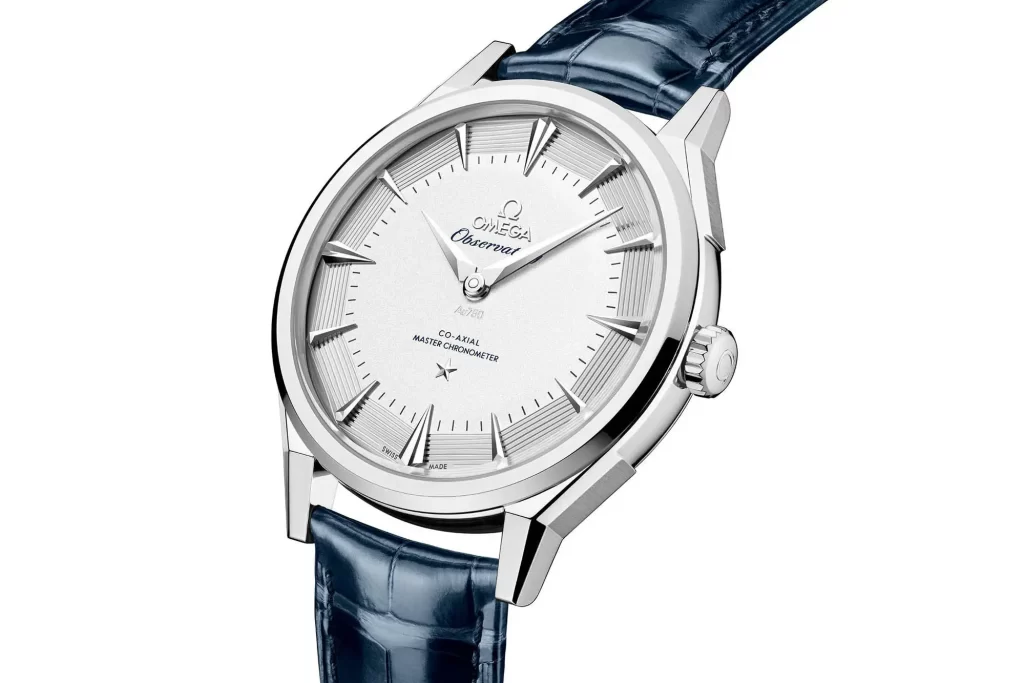
The Constellation Observatory is a 39.4mm dress watch that pulls heavily from Omega’s archive, specifically the Constellations of the 1950s and 60s, a period when the line was Omega’s prestige flagship before the Speedmaster and Seamaster took over.
The Pie-Pan Dial Is Back
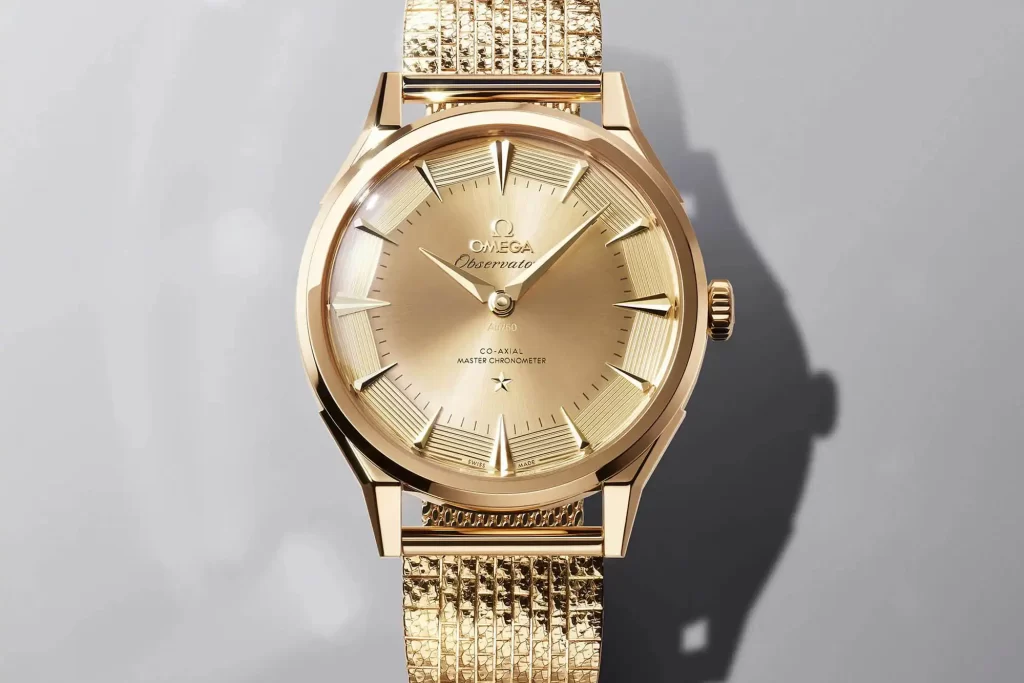
The most immediately striking design on Omega Constellation Observatory element is the dial. Omega has brought back the “pie-pan” shape, a raised central platform surrounded by sloping, angled facets that drop toward the indices. It creates a wonderful sense of depth without being flashy about it.
On the steel models, those facets are stamped with a geometric pattern. On the gold versions, it’s done with a traditional hand-operated straight-line engine, producing a guilloché texture. The eight lines in that pattern are a deliberate nod to the eight stars of the historic Geneva Observatory medallion, which has been part of Constellation DNA since 1952. On the black ceramic dial variant, Omega had to engineer the dodecagonal shape into the ceramic itself, apparently a significant technical challenge that required dedicated R&D.
Dog-Leg Lugs and a Brick Bracelet
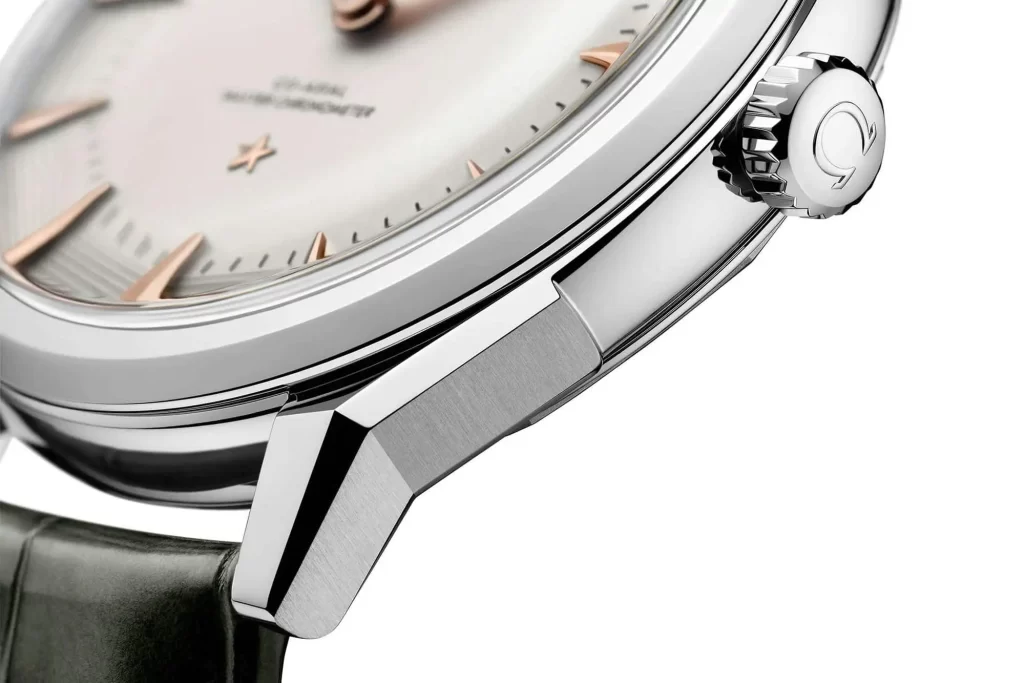
Two more vintage callbacks worth mentioning. The case features dog-leg lugs, those sharply angled, tapered lugs that look a bit like a dog’s hind legs mid-stride. They vanished from the Constellation in the 1970s and only recently reappeared on the limited Seamaster Milano Cortina. Here they’re polished and very much at home.
And for the 18K Moonshine Gold variant, Omega is offering a nine-row brick-link mesh bracelet inspired by the original Constellation bracelets of that era. It’s the kind of detail that will mean a lot to people who know the reference, and will probably look fantastic to everyone else too. The gold one is my favourite model at this point, but the price is a little too big for me.

Two New Calibers
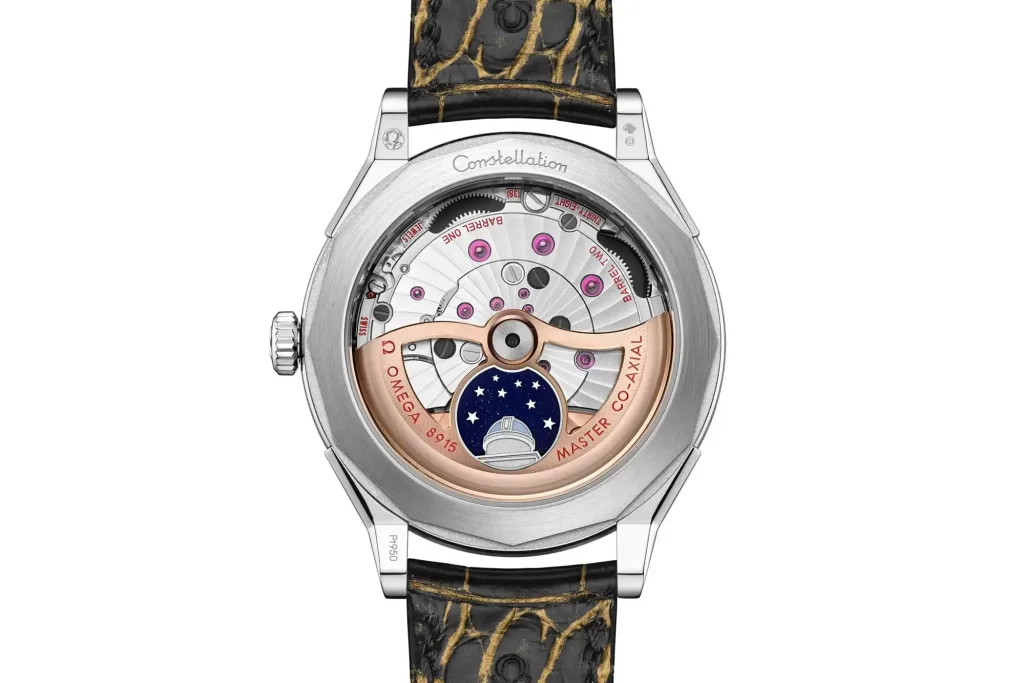
The collection runs on two new movements: Caliber 8914 (fitted to the steel models) and Caliber 8915 (for the precious metal configurations). Both are derivatives of the existing Cal. 8900 series, which has been the backbone of Omega’s Master Chronometer lineup since the Globemaster launched in 2015.
The difference between the two is essentially cosmetic: the 8915 gets an 18K gold rotor and balance bridge matched to the case material: Moonshine Gold or Sedna Gold, depending on the variant. The 8914 uses a rhodium-plated rotor. Functionally, they’re the same movement: co-axial escapement, silicon hairspring, 60-hour power reserve, 25,200 bph.
One thing the SJX team noted, and I think it’s a fair point: the Spirate regulation system, which Omega introduced on the Speedmaster Super Racing, would have been a natural fit on a watch called the Observatory. But it hasn’t appeared here. Whether that changes in the future is anyone’s guess.
Nine References, A Range of Price Points
The Omega Constellation Observatory collection launches with nine references across steel and precious metal tiers. Steel starts at CHF 8,500 (or CHF 9,500 for the black ceramic dial). The gold models range from CHF 29,500 up to CHF 46,000 for the Moonshine Gold with the brick bracelet.
It’s not cheap, obviously. But context matters: this is a dress watch with a genuine technical story behind it, a meaningful design heritage, and a certification process that just wrote a new chapter in watchmaking history.
The Constellation Observatory is the kind of release where the technical achievement and the aesthetic story actually reinforce each other. Omega didn’t just remove the seconds hand for style, they built the science to justify it. And in doing so, they may have changed how chronometer testing works for everyone going forward.
That’s worth paying attention to. I really love when someone plays with their watch like this, using and developing technology just to prove that it can be done in another way.
I was not really a fan of the Constellation line, never thought that I would buy one in the future but this one looks great. It is the first time I’m considering buying one .

Specifications
| Reference | 9 references (140.13.xx / 140.50.xx / 140.53.xx / 140.93.xx) |
| Diameter | 39.4 mm |
| Case Material | O-megasteel, 18K Moonshine Gold, 18K Sedna Gold, 18K Canopus White Gold |
| Crystal | Sapphire |
| Water Resistance | 100 m |
| Movement | Cal. 8914 (steel) / Cal. 8915 (precious metals) |
| Functions | Hours, Minutes |
| Frequency | 25,200 bph (3.5 Hz) |
| Winding | Automatic |
| Power Reserve | 60 hours |
| Certification | Master Chronometer (METAS), Dual Metric acoustic testing |
| Strap/Bracelet | Leather strap or gold brick-link bracelet (Moonshine Gold variant) |
| Limited Edition | No |
| Availability | Now, at Omega boutiques worldwide |
| Price (excl. taxes) | From CHF 8,500 (steel) to CHF 46,000 (Moonshine Gold on bracelet) |
More information on Omega’s official website