After 50 years of using the same accuracy standard, the Swiss Contrôle Officiel Suisse des Chronomètres (COSC) has introduced a new tier of certification called the Excellence Chronometer.
The move comes after years of pressure from within the industry, with major brands like Rolex and Omega having already built their own, tougher in-house standards that made the base COSC benchmark look dated by comparison. The new certification does not replace what COSC has always offered.
It builds on top of it, adding stricter accuracy requirements, magnetic resistance testing, verified power reserve, and a protocol that tests movements both before and after they are cased. Testing begins in March 2026, with full deployment set for October. For brands that rely on COSC as their primary third-party certifier, this is the most meaningful update the organisation has ever made.
What is COSC ?
The Swiss Contrôle Officiel Suisse des Chronomètres, better known as COSC , was founded in 1973. Its purpose was to bring structure to a fragmented testing landscape. Before COSC, the job of certifying a watch movement’s accuracy was handled by individual observatories, each running their own procedures.
COSC pulled all of that under one independent roof, and over the following decades its certification became the most widely recognised accuracy credential in the Swiss watch industry.
Fifty Years of the Same Rules
For 50 years, earning a COSC certificate meant meeting a single set of requirements. Testing followed ISO 3159, ran for 15 consecutive days, and covered multiple positions and temperature conditions. The core threshold was an accuracy range of -4 to +6 seconds per day, a 10-second window that became the default benchmark for the industry. For most of that time, it was enough for Luxury brands or more affordable ones.
But movements improved. Manufacturing tolerances tightened. And several major brands began to question whether a 10-second daily variance still reflected what their calibres were actually capable of. Instead of pushing for a COSC update, some of them built their own programmes.
The Competition That Pushed COSC to Act
COSC does not operate in isolation. Over the past two decades, brands that had long relied on the organisation started introducing tighter internal standards. The message was clear: the base COSC certification was no longer telling the full story. And I agree with them.

Rolex and Omega Raise the Bar
Rolex introduced its Superlative Chronometer designation, which requires accuracy within −2/+2 seconds per day , a significantly tighter window than the COSC base standard.
Omega took a different approach in 2015 with its Master Chronometer programme, certified by METAS, the Swiss Federal Institute of Metrology. The METAS standard requires movements to perform between 0/+5 and 0/+7 seconds per day and includes magnetic resistance testing as well as certification of the fully cased watch, not just the bare movement.
Both programmes addressed something the old COSC framework did not: real-world conditions. They tested finished watches. They checked for magnetic resistance. They gave consumers a clearer picture of what a watch could handle day to day. COSC, sitting with the same standard it had used since 1973, needed a response. Rolex and Omega goes head to head in everything they do. And I love it, competition is ultimately good for us, the consumers.
The Excellence Chronometer: What Changes
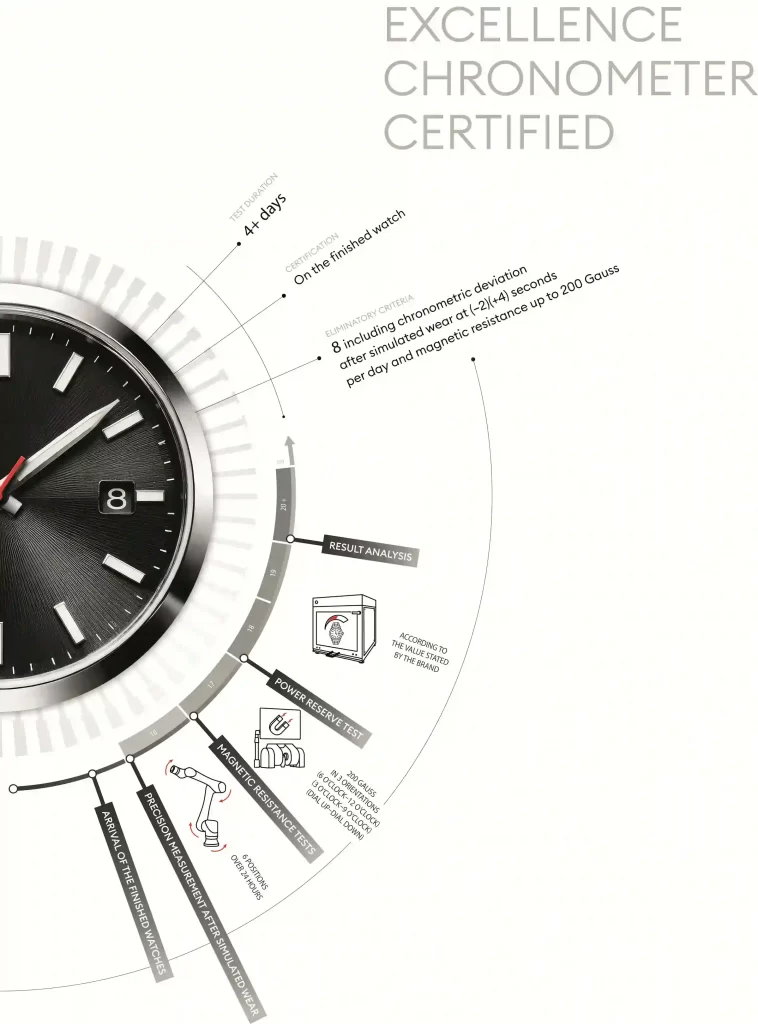
The Excellence Chronometer is COSC’s answer. It is not a replacement for the existing COSC certification but an extension of it. Any movement earning this designation must first clear the standard 15-day COSC tests. After that, three new requirements come into play.
New Requirements
The first is a tighter accuracy range. Where the standard COSC allows for a 10-second daily spread, the COSC Excellence Chronometer cuts that window to 6 seconds. That is a 40 percent reduction in allowable deviation.
The second is magnetic resistance, verified up to 200 Gauss. The standard COSC test does not cover magnetic fields at all, which is a gap that has grown harder to ignore. Smartphones, laptop speakers, bag clasps, and airport equipment can all expose a watch to magnetism that affects rate accuracy. This new requirement directly addresses that.
The third is a verified power reserve. Under the Excellence Chronometer, the power reserve of each movement is confirmed as part of the certification process, adding a functional check that goes beyond rate measurement.
Uncased and Cased: Testing Both States
One of the more significant structural changes in this new standard is that movements are tested both before and after casing. The case affects how a movement behaves , the fit, the crown seal, the way vibration travels through the watch. Testing only an uncased movement gives a partial picture. COSC’s Excellence Chronometer closes that gap, bringing its approach closer to what Rolex and Omega have been doing with their own programmes.
The overall testing period also extends. The new standard adds five days to the existing 15-day protocol, making it a 20-day process in total. As with all COSC certifications, this applies to each individual movement, not to a reference batch.
Timeline and What Comes Next
COSC has published a clear schedule. Testing under the Excellence Chronometer standard is set to begin in March 2026, with full deployment planned for October 2026. That gives manufacturers roughly six months from the start of testing to align their production and certification pipelines.
Whether brands adopt the new tier in large numbers is an open question. Rolex and Omega, which already operate strong in-house programmes, have little need for another credential. But for the many brands that rely on COSC as their primary third-party certifier, the Excellence Chronometer offers something the base standard never did: a way to demonstrate a higher level of performance backed by independent verification.
The watch industry’s tolerance for accuracy claims has shifted. Buyers are better informed, and the gap between a brand’s marketing language and what its movements can actually do has become harder to hide. COSC’s new standard is a practical acknowledgement of that reality , tougher testing, more days, real-world conditions, and a result that means more than the certificate that came before it.
I’m going to be honest, I still don’t really understand if the old standard will be fully replaced by the new one in the future, or the manufacturers can choose what standard they want. Because if they let them chose, then they had accomplished nothing and some marketing deceitful schemes may arise from this.
More information about COSC Excellence Chronometer can be found on COSC website