

Deloitte Swiss Watch Industry Study shows us that the post-pandemic boom was not a new normal and there were too many watches in the market from brands that had inflated desirability and business performance.
Three brands have “ruled” the market during the pandemic and after, Rolex, Patek Philippe and Audemars Piguet. Alongside them, other brands exploited the fact that people started to buy watches.
A traditionally resilient industry in continue change
Global inflation put all the watch industry under pressure, which softened the luxury demand. But Swiss Watch exports continue to perform strongly, especially in mid and high segments.
Deloitte watch report 2025 reveals that more than half of the luxury brands expect moderate revenue growth through 2026.
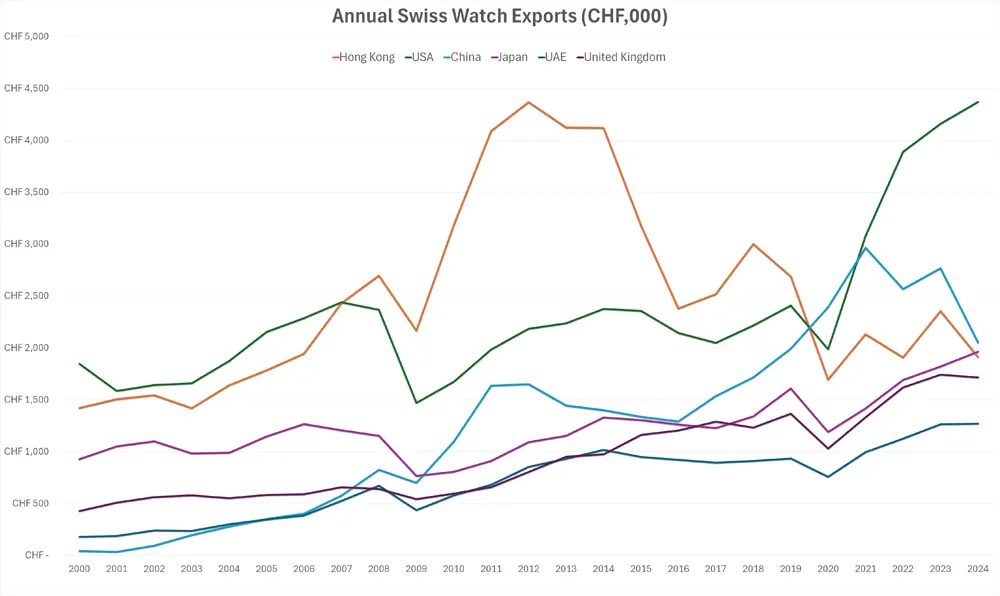
This is due to the shift brands had taken in recent years, changing their sight from the Asian Market, especially China and Hong Kong, and started to look again to the West, beyond traditional markets like Europe or Asia.
Starting with 2020, we can see an increase of Swiss Made Watch exports to the markets like USA, UK, Japan and a decrease for countries like China or Hong Kong.
Younger Generation is the fuel for growth engine
Millennials and Gen Z consumers are central to the market expansion, because they value authenticity, individuality and these things are reshaping how luxury houses communicate.
Deloitte notes that these groups favor vintage and limited-edition watches which in my opinion reflects the cultural shift toward sustainability and personalization.





Sustainability is Strategic Imperative for some Brands
Around 45% of industry leaders see environmental responsibility as a top-three challenge. Sustainability emerges not as a trend, but as a necessity. Brands like IWC or Panerai or even Ulysse Nardin, continue leading with recycled materials and a transparent sourcing.
With the help of blockchain integrations it helps them track component origins.
Retail is still Big
In a time when we do almost everything on a computer and internet, especially shopping, in the watch industry and market, things are a little different. Digital sales have matured, but brick and mortar experience remains irreplaceable.
Over 60% of respondents believe in the coexistence of brick and mortar and online stores. And it makes sense when you think about it. You buy a 20.000 Dollar/EUR/Pounds watch, you want the full experience, the champagne, the treatment, the respect. All this is lost when you just pay the same amount online.
It’s fast, but you don’t have the king treatment.
Pre-Owned Market continues to expand according to Deloitte watch report 2025
The secondary market is predicted to surpass CHF 35 billion in 2026. Marketplaces like watchfinder or watchbox are transforming consumer trust. Of course the secondary market has a lot of products that are basically new.
The growth is fueled also by the big demand for Rolex, which is very hard to buy from an official boutique, and you end up paying extra for a new one from sellers on the secondary market.
We should keep that in mind as well.
Also it’s worth mentioning that industry insiders predict continued consolidation and internationalization. Independents like F.P Journe or MB&F are gaining traction alongside industry giants.
About Deloitte Swiss Watch Industry report
Deloitte watch report 2025 started before Trump announced new tariffs. So this was the backdrop to the research. The report is based on interviews with executives from the industry. While most of them are anonymous, some of them are quoted.
A total of 111 executives had been interviewed alongside 6500 consumers from countries like: Switzerland, China, France, Germany, Hong Kong, India, Italy, Japan, Singapore, UAE, UK and USA.
Interviews were conducted in June and July, just before Trump announced the tariffs that hit Swiss watchmakers that took the rate to about 41% increase for every watch that is sent to the USA.
So the optimistic tone might be tuned down a little bit at this point. So it is possible to see some decrease in the exports and for sure increases in the prices, at least for the USA market.
This is a small analysis and presentation of the report, if you want to read it in full, you can find it here.