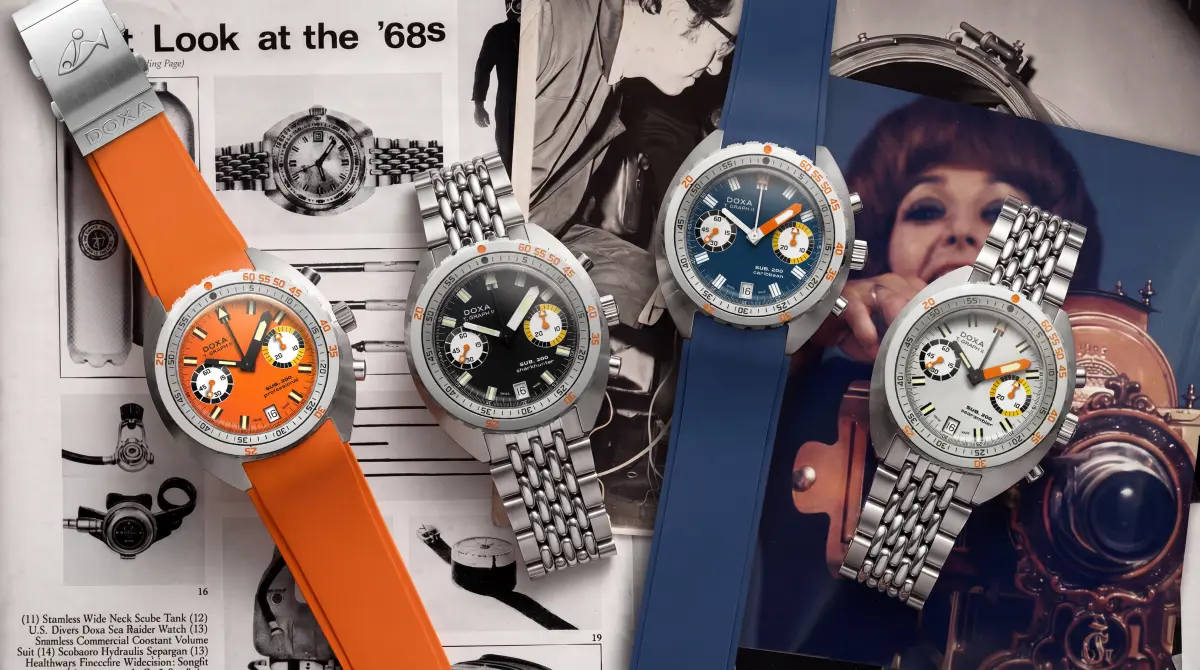
There’s a certain type of watch person who hears “dive chronograph” and immediately gets suspicious. Is it a diver pretending to be a chronograph? A chronograph that got too close to a pool? The Doxa SUB 200 T.Graph II doesn’t have time for that conversation. It showed up in 1969, the same year humans walked on the moon and half a million people turned a farm in upstate New York into a legendary muddy mess. It had a job to do, and it did it. Now, nearly 60 years later, it’s back and it still has that same energy.
I said it in my James Bond Seamaster Chronograph article that I don’t really like the Dive Watches that have chronographs as well, and only a few of them are actually looking good. Well, this one is one of the watches that looks good.
A Brief History of the T.Graph
The original T.Graph, introduced in 1969, took Doxa’s proven dive watch formula and added a chronograph complication, making it one of the earliest dive-focused chronographs on the market. That was a strange idea at the time and still is in my eyes. Dive watches were serious business. Chronographs were for pilots and racing drivers. Putting the two together felt a bit like adding a sunroof to a submarine and still feels this way.
But it worked. While it may not have shaken the horological world upon its release, it became a highly collectable cult icon in the years since. Doxa released a 50th anniversary limited edition reissue back in 2019, and those models became as sought after as the originals. So a full comeback was only a matter of time.
What’s New (Without Breaking What Was Good)
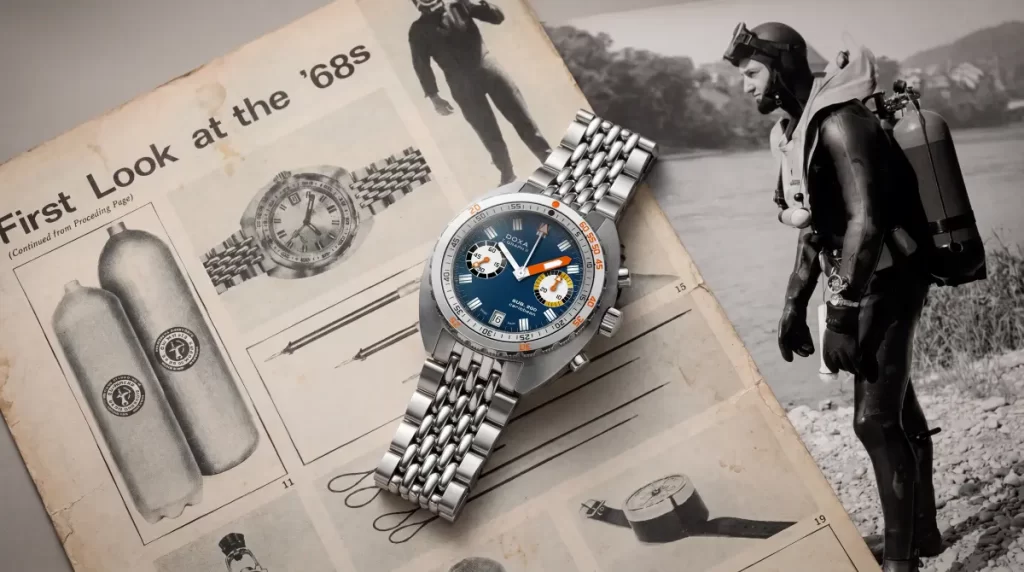
The new SUB 200 T.Graph II comes in at 42mm wide and 14.6mm thick, just a little bit smaller than its predecessor’s 43mm x 15.15mm profile. On paper, that sounds like nothing. In real life, on your wrist, it’s the difference between a watch that sits comfortably and one that announces itself before you do when you walk into a room. The watch enters first and then you follow. Kidding.
The iconic cushion case is still here. The geometry has been dialled in so it wears without excess drama across a wider range of wrist sizes. Smart move. Not every diver has the wrists of a Russian submarine captain.
The watch still carries its 200-metre water resistance, screw-down crown, and screw-in caseback. The unidirectional bezel clicks, holds, and refuses to budge, exactly as a bezel for divers should behave.
The Dial: Busy Is a Four-Letter Word
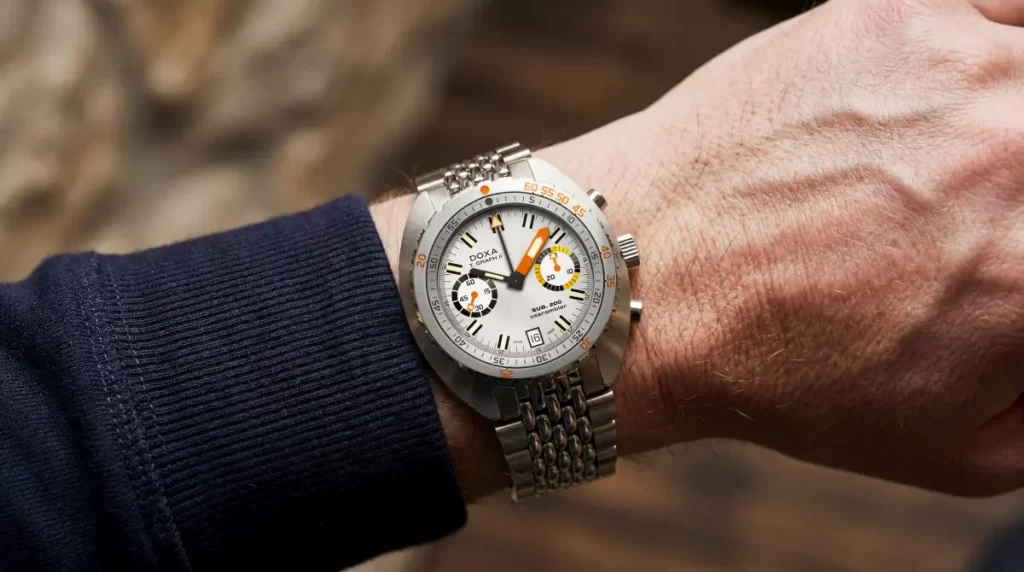
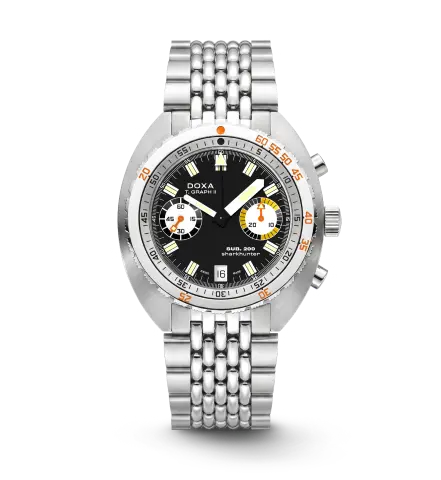
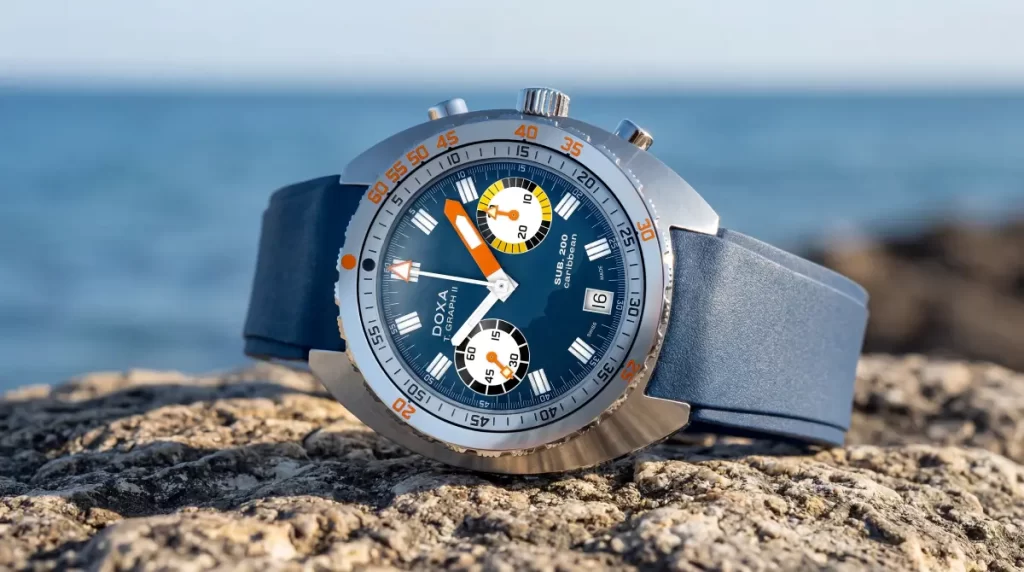
Under the sapphire crystal with AR coating, the layout is exactly what you want from a Doxa: bold printed indices loaded with Super-LumiNova, a 30-minute chronograph counter at 3 o’clock, a 60-second counter at 9, and a date window sitting cleanly at 6. No clutter. Just the information a diver needs, arranged logically and orderly.

Chronograph dials have a bad habit of looking like someone dropped an instrument panel and just glued it back together. The T.Graph II manages to avoid that fate. The yellow-accented 30-minute counter at 3 o’clock is a nice detail, it gives you something specific to look at, which is more useful than you’d think when you’re 20 metres down and a fish is distracting you. Or worse, a shark…
The Colour Situation of Doxa SUB 200 T.Graph II
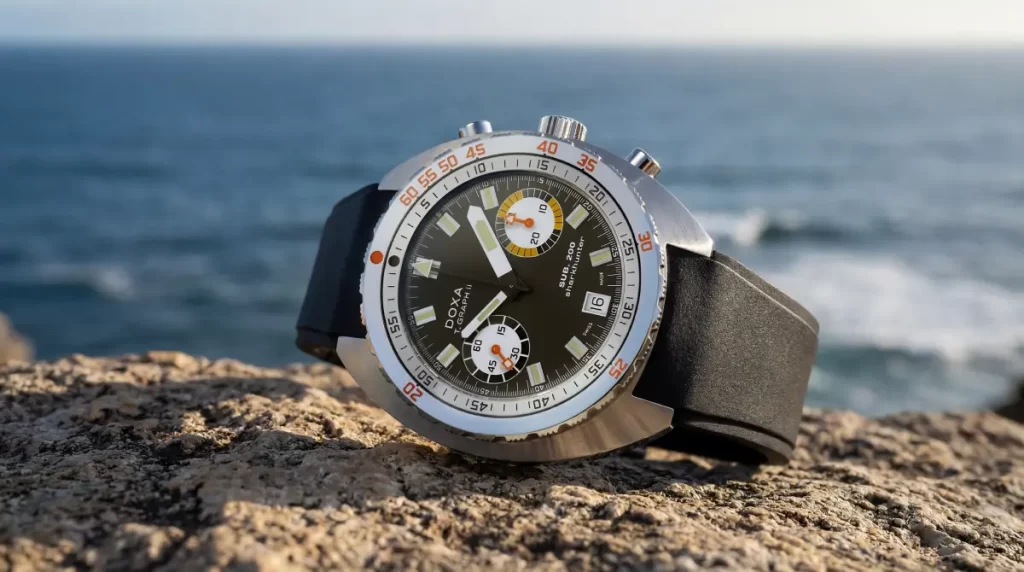
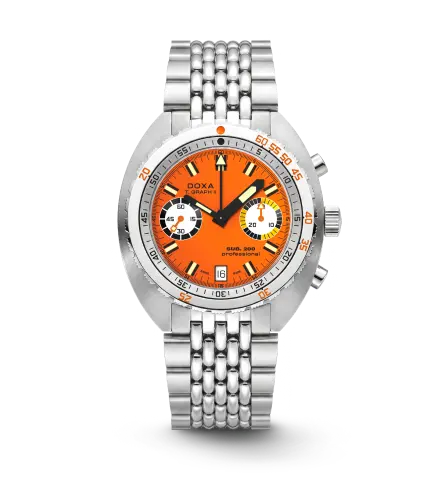
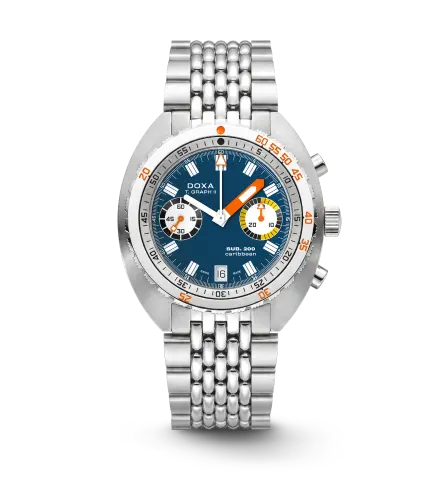
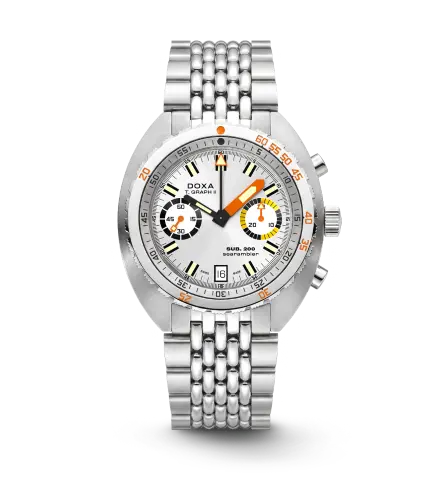
The T.Graph II launches with four dial options: Professional orange (the original), Sharkhunter black, Searambler silver, and the newcomer to the lineup, Caribbean Blue. Doxa’s orange is one of those colours that either speaks to you immediately or makes you wonder what they were thinking. There is no middle ground. The Sharkhunter black is the serious option for people who want a tool watch that doesn’t announce itself at the table
The Caribbean Blue is deep, dark, borderline-navy with just enough shift in the light to remind you it’s not just another dark dial. On the colour-matched rubber strap, the whole thing reads as one cohesive object, less a watch on a strap than a single piece of gear.
The Movement: Honest and Unashamed
Inside sits the Sellita SW510 automatic chronograph calibre, beating at 28,800 vph with a 56-hour power reserve. It’s not in-house. It’s not hand-finishing art. It’s a movement that does what it says on the paper, reliably, for a long time.
This is a tool watch company. They source an honest, reliable movement, lightly decorate it with their own name, and focus their energy on what the watch does rather than what the movement looks like. That’s the appropriate philosophy for a watch like this. Respect.
Dive Watch First, Chronograph Second
This is worth saying clearly, because it changes how you think about the whole thing. The T.Graph II is not a chronograph that dives. It’s a dive watch that also has a chronograph. The timing bezel is still your primary instrument underwater. The chronograph exists for everything else, surface intervals, decompression stops, timing a safety stop, knowing how long you’ve been drifting in current while your buddy sorts out their reel. It’s a backup capability built into the platform without compromising the platform itself.
That philosophy has been consistent since 1969. It’s one of the reasons the watch makes sense when so many dive chronographs don’t.
Strap Options and Price
Doxa SUB 200 T.Graph II is available on a stainless steel beads-of-rice bracelet or a rubber strap in black or dial-matched colour. Both come with a folding clasp and wetsuit extension. The price difference between bracelet and strap is about $40, one of the fairer decisions Doxa makes.
Pricing sits at EUR 3,950 / USD 4,250 on rubber and EUR 3,990 / USD 4,290 on the bracelet. That puts it in a competitive neighbourhood with other serious dive chronographs, but few of those come with 55 years of dive watch heritage, four historically-grounded dial colours, and a story that starts in the same year as Woodstock and the moon landing.
But, I feel like this is a little too expensive for a DOXA, but that is only my opinion. Keep in mind though that DOXA SUB 300 Beta Ceramic Dubai Watch Week Edition costs roughly the same. And you get a limited piece.
Final Thought
The Doxa SUB 200 T.Graph II is not trying to reinvent anything. It’s a refinement of something that was already right. A little smaller, a little more wearable, with a new blue option for people who’ve always wanted one, and the same no-nonsense attitude that made the original worth bringing back in the first place.
If you go in the water, this deserves your attention. If you don’t go in the water, you probably still want it on your wrist. That orange dial has a way of convincing people. Still if you want a DOXA but you feel like this one is too expensive, you have the option to buy the DOXA SUB 200 II which is way more cheaper than this.
Specifications Table
| Specification | Details |
|---|---|
| Brand | Doxa |
| Model | SUB 200 T.Graph II |
| Case Diameter | 42mm |
| Case Thickness | 14.6mm |
| Lug-to-Lug | 44.5mm |
| Lug Width | 20mm |
| Case Material | 316L Stainless Steel |
| Crystal | Sapphire with AR coating |
| Bezel | Unidirectional, stainless steel, 60-minute scale |
| Water Resistance | 200 metres |
| Movement | Sellita SW510, automatic chronograph |
| Frequency | 28,800 vph |
| Power Reserve | 56 hours |
| Functions | Hours, minutes, seconds, date, chronograph (30-min counter) |
| Dial Options | Professional Orange, Sharkhunter Black, Searambler Silver, Caribbean Blue |
| Strap Options | Steel beads-of-rice bracelet / rubber strap (black or color-matched) |
| Clasp | Folding clasp with wetsuit extension |
| Price (rubber) | CHF 3,650 / EUR 3,950 / USD 4,250 |
| Price (bracelet) | CHF 3,690 / EUR 3,990 / USD 4,290 |
| Availability | Available now, permanent collection |
More info for the watch on their official website