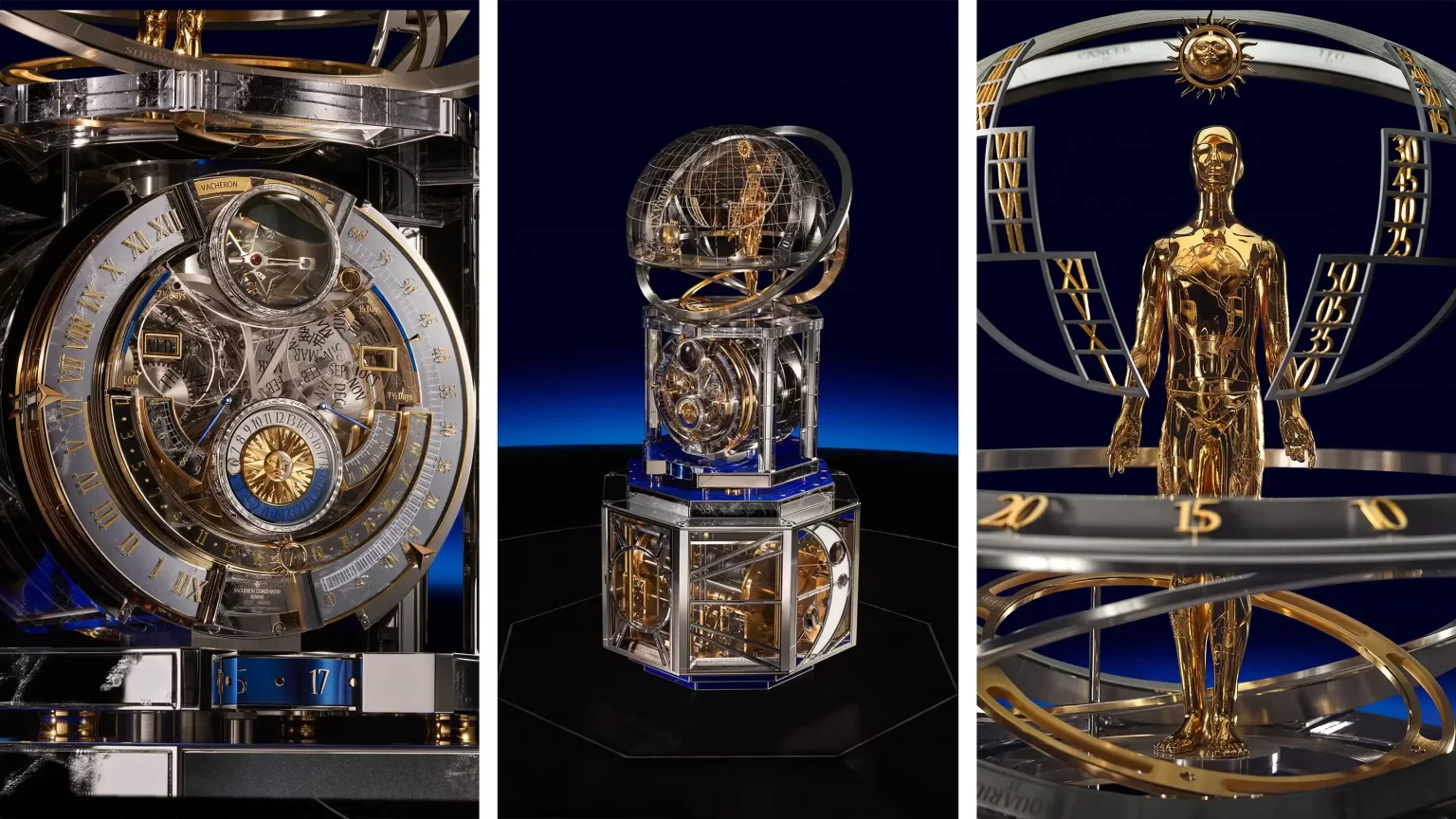
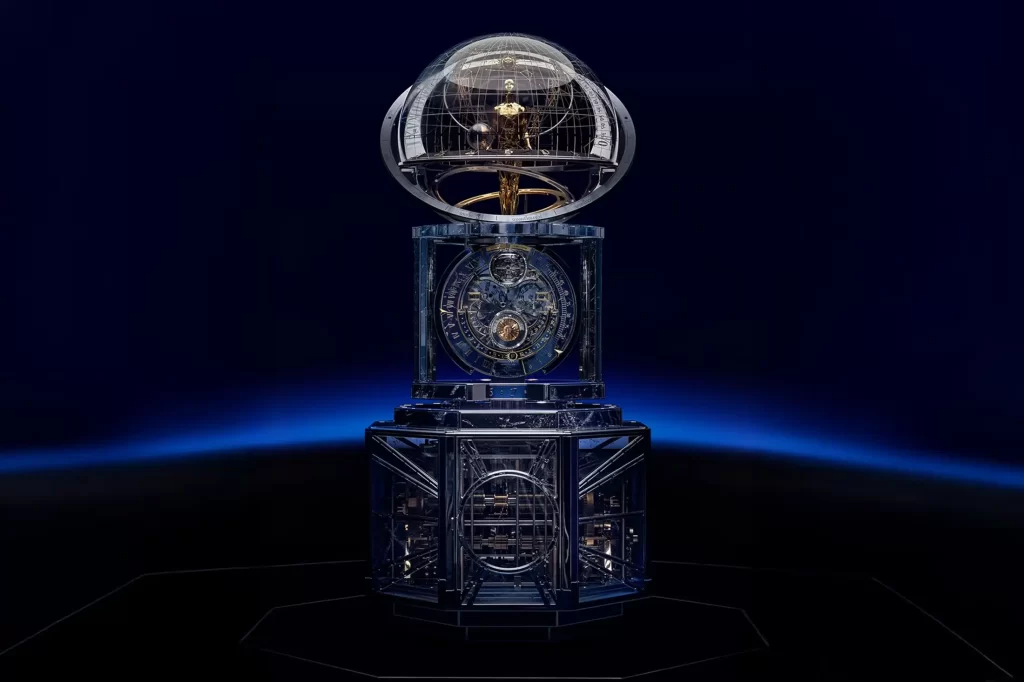
When it comes to horological achievements, Swiss Made creations go beyond the boundaries of timekeeping and become monuments of human ingenuity. That is the case with Vacheron Constantin La Quête du Temps, a clock that weighs approximately 250 kilograms and stands one meter tall.
- The Quest Revealed: Beyond Traditional Horology and the Quest of Time
- La Quête du Temps the architecture of Astronomical Wonder
- The Astronomer: Francois Junod’s creation from Bronze
- The Dome of Time and Geneva Sky of 1755
- Métiers d’Art: Returning to La fabrique Tradition for La Quête du Temps
The Quest Revealed: Beyond Traditional Horology and the Quest of Time
The theme of this year, in which Vacheron Constantin celebrates its 270 years anniversary has been defined as “The Quest”- but no one had any idea what they are referring to. A quest to what? Now we have the answer!
A defining journey shaped by creativity, passion and the pursuit of perfection. And I think that they completed the quest because the end of it culminates with a clock that doesn’t just tell the time, it performs it.
It took them 7 years to make this clock and they collaborated with watchmakers, artisans, engineers, astronomers , casemakers at L’Épée and the world famous automatier François Junod.
This creation breaks the conventional rules of horology. Time doesn’t matter anymore, it’s about the choreographed dance of time itself. It doesn’t tell time, it gives you a show.
Also the clock is accompanied in this launch by a wristwatch called “Métiers d’Art Tribute to The Quest of Time,” which I covered in a separate story.
Partnership with the Louvre
Vacheron Constantin has a partnership with Louvre and they created some watches in the collection called Métiers d’Art .
Thanks to this partnership , this 21st-century piece has earned a rare chance and honour, I would say, to be displayed alongside ten works from the museum’s permanent collection, some dating back to 332 BC.

This inclusion is noteworthy because the Louvre rarely displays objects from the modern era, so La Quête du Temps becomes a bridge between horological antiquity and modern innovation.
La Quête du Temps is open to public from September 17 to November 12, 2025.

La Quête du Temps the architecture of Astronomical Wonder
It really is a pleasure to write about this clock and definitely it’s a bigger pleasure to see this in person, so if you are in France or planning a trip in that period, be sure to go and see this masterpiece.
The Caliber 9270- Incredible Engineering
Each Clock or watch needs a heart. In this case we have the custom designed Caliber 9270, a movement that is bold and defies conventional watchmaking.
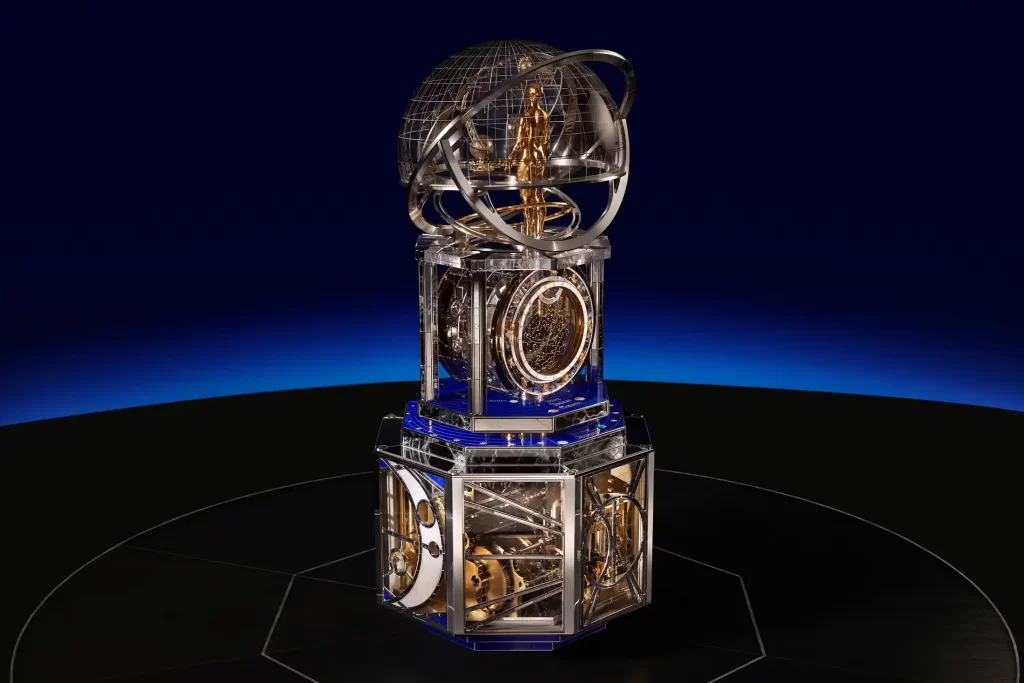
The clock has three interconnected sections: the dome, the astronomical clock and the base, each serving a distinct but harmonious function and creating an horological symphony.
Movement Features
| Specification | Details |
| Dimensions | 223mm x 262mm x 262mm (thickness) |
| Power Reserve | 15 days via five barrels, plus one additional barrel for retrograde moon |
| Components | 2,370 parts with 148 jewels |
| Frequency | 18,000 vibrations per hour |
| Escapement | Tourbillon with 18.8mm balance wheel |
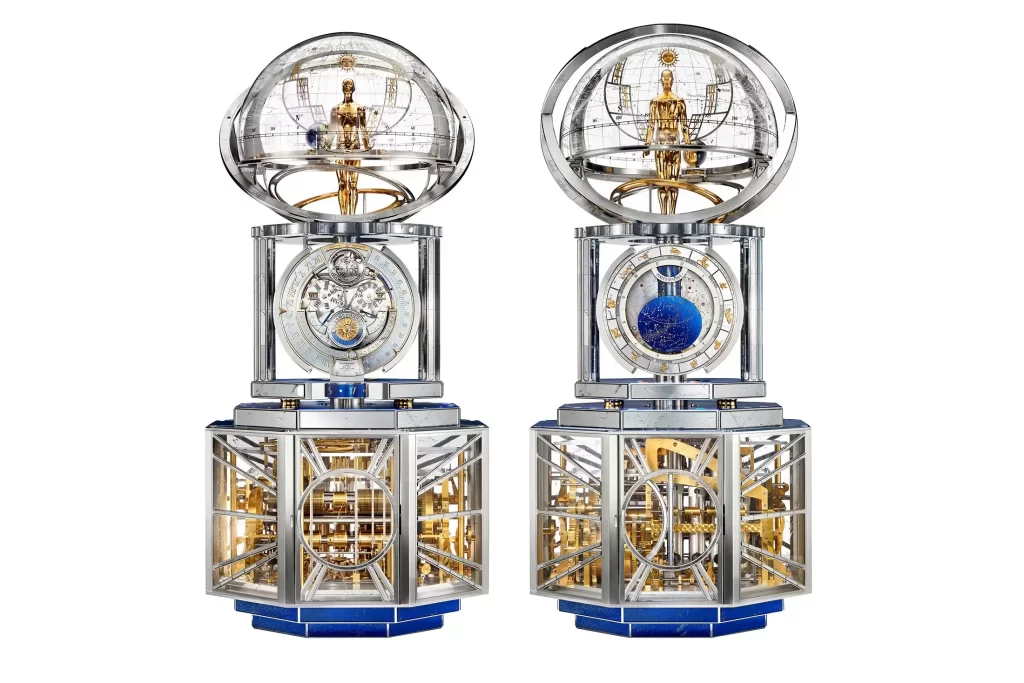
Twenty-Five complications that works in Perfect harmony for La Quête du Temps
La Quête du Temps is not a simple clock, we established that at the beginning of the article, and i wont speak about them individually because this article would be too long and you wouldn’t read it. So here is a list:
- Retrograde hours and minutes displayed through the automaton’s gestures
- Double-retrograde power reserve indicators
- Gregorian perpetual calendar
- Sunrise and sunset indications for Geneva’s latitude
- Real-time celestial vault tracking sidereal time
- Seasonal and zodiacal indications
- Precision moon phase display accurate for 110 years without correction
- A rotating three-dimensional moon with retrograde function
The Tourbillon alone gets the attention with its 28mm Maltese cross designed cage, magnified by “cyclops” lens. It is also surrounded by baguette-cut diamonds that capture your eyes into the movement mechanical heart.
The Astronomer: Francois Junod’s creation from Bronze
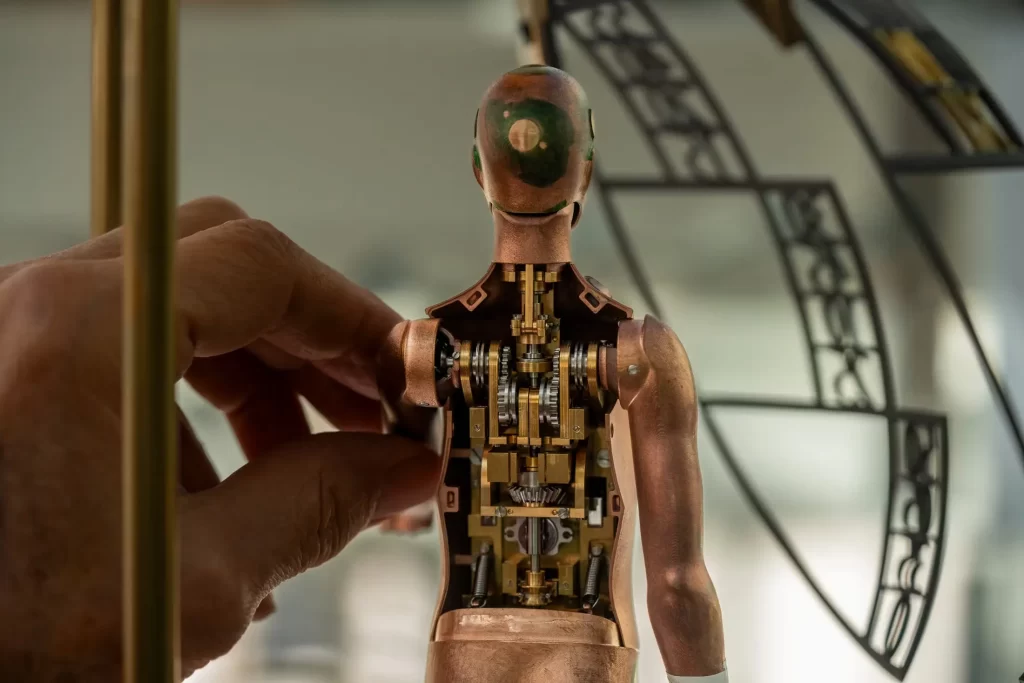
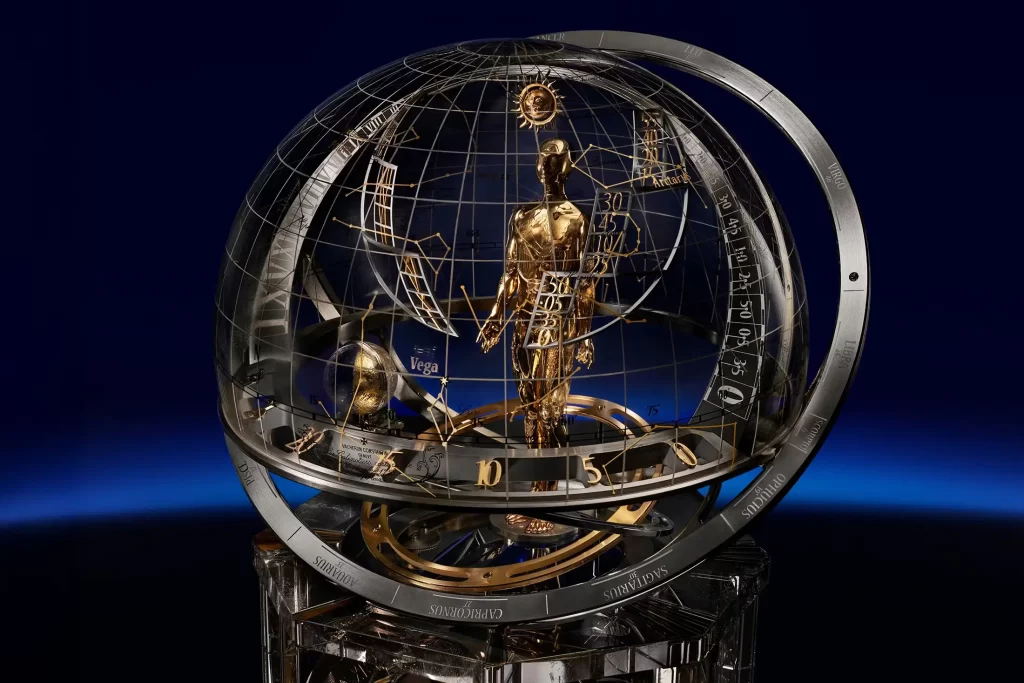
The centrepiece of La Quête du Temps is the Astronomer (yes, that is the name of the doll) and it’s a bronze automaton that represents the first automaton that serves as a functional time-telling complication.
The Astronomer was crafted in collaboration with master automatier Francois Junod and it performs three distinct sequences totaling one and a half minutes of choreographed motion.
The sophistication of the automaton lies in its unpredictability. The time scales that are floating besides the Astronomer display hours in Roman numerals and minutes in Arabic numerals , but not in sequential order because they are randomly arranged.
In this way, each time the Astronomer indicates the time, the gesture is slightly different because the figure must point to the correct numbers.
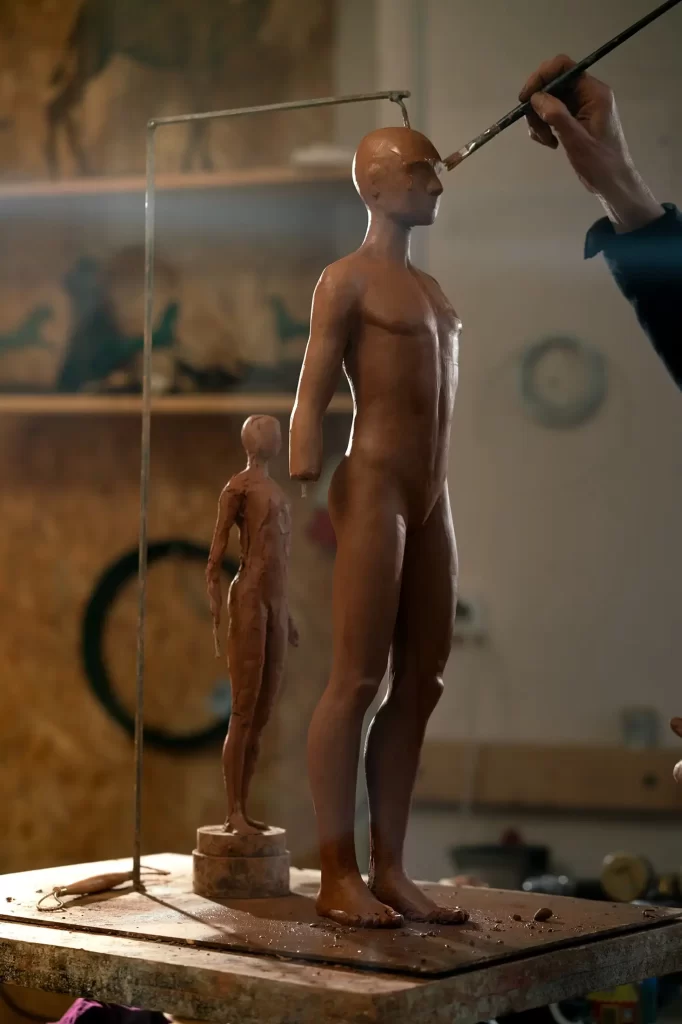
The creation wasn’t easy, first it was sculpted in wax, then scaled up to a larger wax figure and the final version was cast in bronze across eight articulated sections.
The Music behind the Time Telling with La Quête du Temps
Beyond the visual spectacle that the whole clock is displaying, La Quête du Temps also engages the auditory sense through its…let’s call it “music machine” .
The Music Machine features two instruments-a metallophone and four wah-wah tubes and the system comprises 534 of the base’s 3923 components.
The cool part is the music, which was composed specifically for Vacheron Constantin by Woodkid. I’m a fan of his. I hope you listened to his music as well.
I forgot to mention that the automaton can be programmed in advance, up to 24 hours, thanks to a mechanical memory system that stores civil time information which is transferred to the automaton through lateral cam movement.
But, due to the immense power required to animate the Astronomer, the automaton can only perform three times per each winding.
The Dome of Time and Geneva Sky of 1755
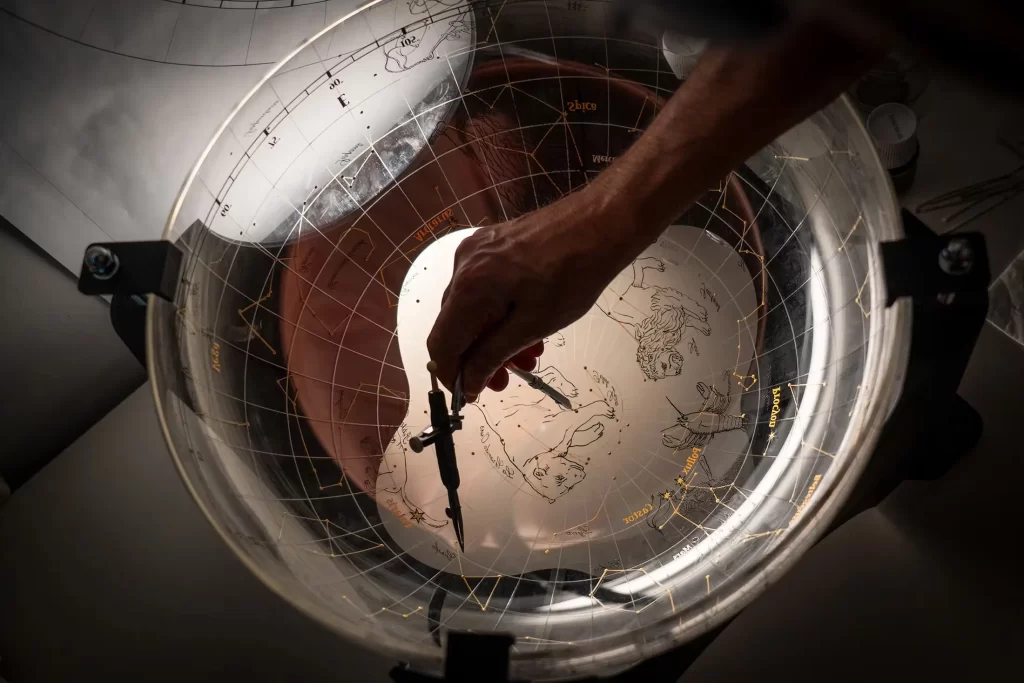
The glass dome is measuring over 40 cm in diameter and houses a celestial vault painted with constellations positioned exactly as they appeared over Geneva on September 17, 1755. You guessed it, it is the date when Vacheron Constantin was founded.
They consulted with the Geneva Observatory ensuring that the painted stars reflect genuine celestial positioning rather than artistic interpretation. And this is a very cool way to celebrate your birthday, Vacheron.
Recently Breguet launched a watch to celebrate their anniversary but it doesn’t come close to this. I wrote everything about their celebrations with the newly Breguet Marine Horus Mundi 5555 .
Within the cosmic sphere, we have a three-dimensional retrograde moon that travels gently through the sphere, while the day and night indications play out at the Astronomer’s feet.
The dome also have a golden sun and some easter eggs related to that historic night Sky, for those who are passionate about these things and take time to study the details. Seems like a job for professor Langdon from the Da Vinci Code movie.
The miniature Solar System
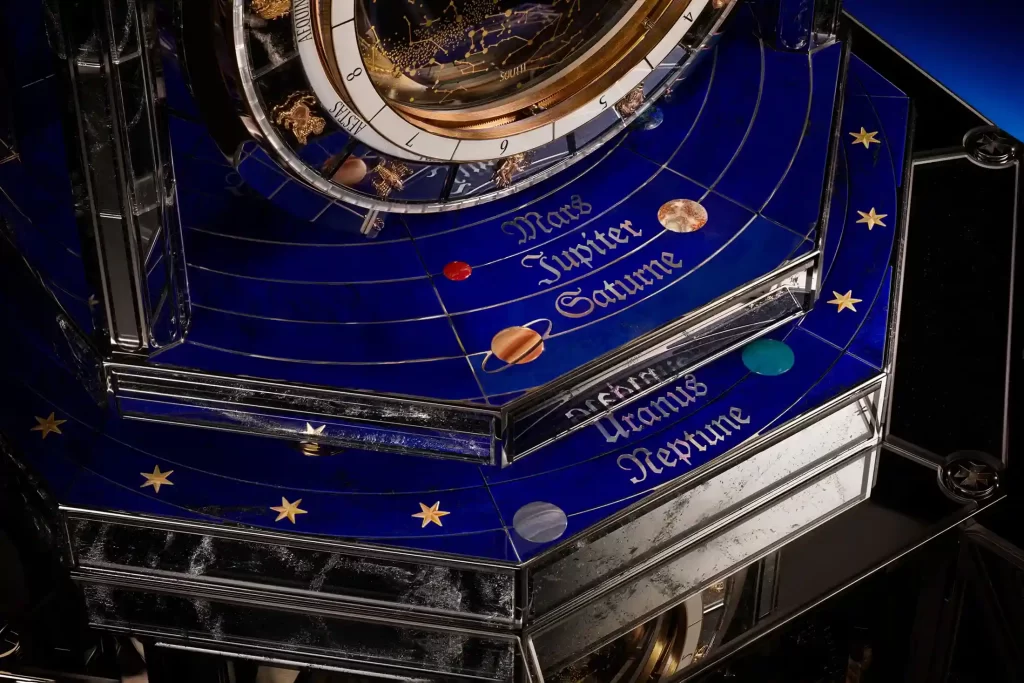
Well , you have an Astronomer, of course you will have a solar system as well. The Base of La Quête du Temps transforms into a miniature solar system, with cabochons of ornamental stones which represent the planets.
The celestial map begins with the sun at the front and concludes with the moon on the back. The names of the planets appear in mother-of-pearl inlay, adding yet another layer of artisanal craftsmanship.

Métiers d’Art: Returning to La fabrique Tradition for La Quête du Temps
In creating this beautiful clock, Vacheron Constantin returned to the 18th and 19th century La Fabrique tradition, where the best craftsmen collaborated to create exceptional products.
This approach is kinda contradictory with the obsession we all have with “in-house” manufacturing, and it’s embracing the specialized expertise that comes from different craftsmen that are specialized in their individual crafts.
The case for example, was created in collaboration with L’Épée 1839 (recently acquired by LVMH), and this is a very rare cooperation because you don’t see each day two competing luxury groups working together.
Of course , a lot of patents were developed by Vacheron Constantin, seven to be exact, in making this clock, which makes it a truly innovative timepiece.
And there is a lot to say about this clock, but the article will be way too long. It was a hard article to write, because when I’m looking at the pictures I feel the need to use sophisticated words, and it’s not really the case, it’s a cool clock, but I want to be as clear as I can.
| Specification | Details |
|---|---|
| Model | La Quête du Temps (The Quest of Time) |
| Type | Astronomical Clock with Automaton |
| Height | 1,070mm (3 feet 6 inches / 107cm) |
| Diameter | 503mm (1 foot 7.8 inches / 50.3cm) |
| Weight | Approximately 250kg (550 lbs) |
| Movement | Calibre 9270 – 223mm x 262mm |
| Power Reserve | 15 days (5 barrels + 1 for retrograde moon) |
| Components | 6,293 mechanical components + 1,020 habillage components |
| Complications | 23 complications including perpetual calendar, moon phases, astronomical indications |
| Automaton | “Astronomer” figure with 144 different gestures, 158 cams, 379 components |
| Patents | 7 patents filed |
| Development Time | 7 years |
| Materials | Stainless steel, rock crystal, lapis lazuli, bronze, 18k gold, diamonds |
| Availability | Unique piece – On display at Louvre Museum (Sept 17 – Nov 12, 2025) |
| Price | NOT FOR SALE – PRICELESS MUSEUM PIECE |