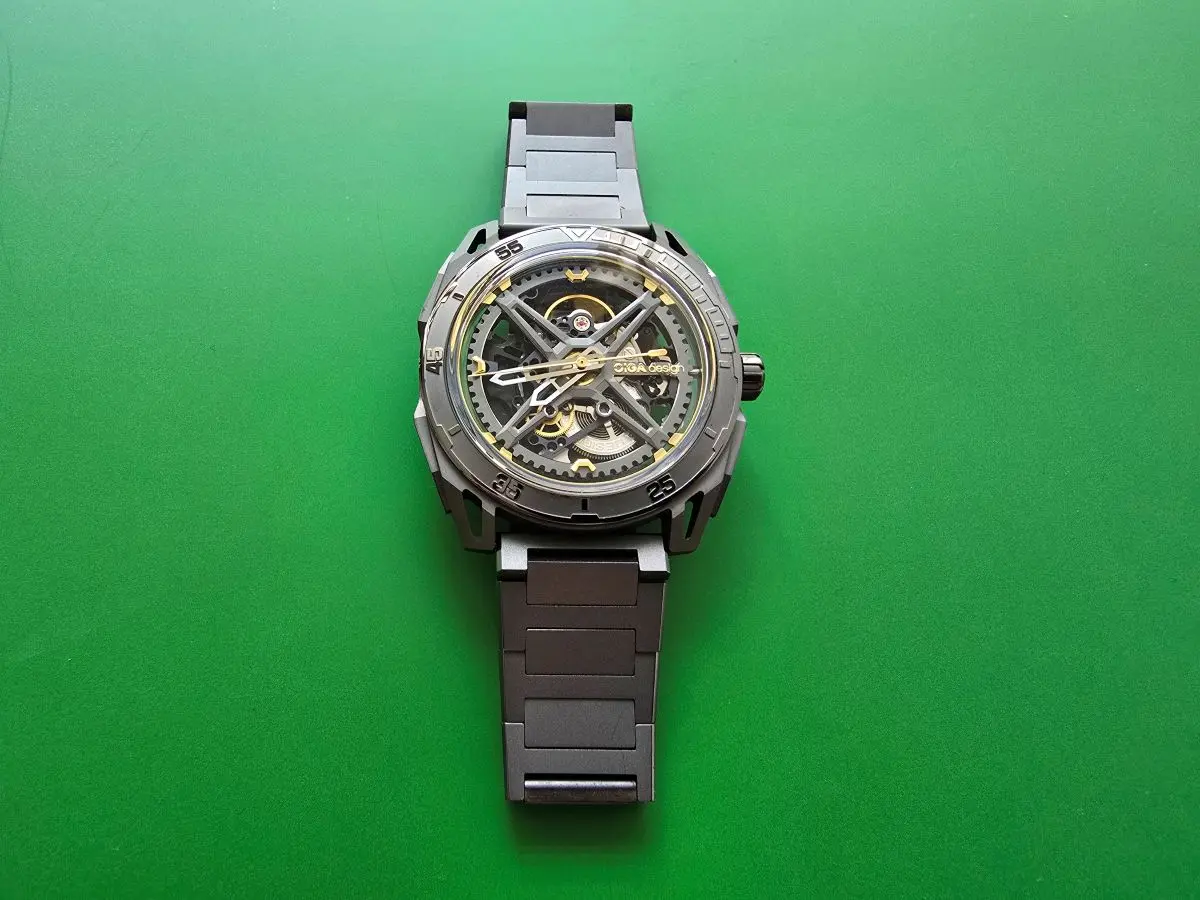
There is a version of this watch that costs $5,000. It comes from a Swiss brand with a long heritage, a boutique in Geneva, and a very impressive marketing budget. You buy it, you wear it, and your friends nod politely. Then someone shows up wearing the CIGA Design Falcon. It costs $499. People stop and ask what it is. OK, maybe I exaggerated a little bit. But this watch looks really cool.
That is the CIGA Design Falcon in a nutshell: a fully skeletonized automatic watch with a self-developed in-house movement, a sharply executed 316L steel case, and a price that makes no logical sense given what you get. It targets design-driven collectors, watch enthusiasts on a budget, and anyone who wants a wrist piece that genuinely turns heads without turning their bank account into a casualty.
This is not a luxury watch. It is something more interesting: an affordable watch that refuses to act like one.
Design and Aesthetics of CIGA design Falcon
Case
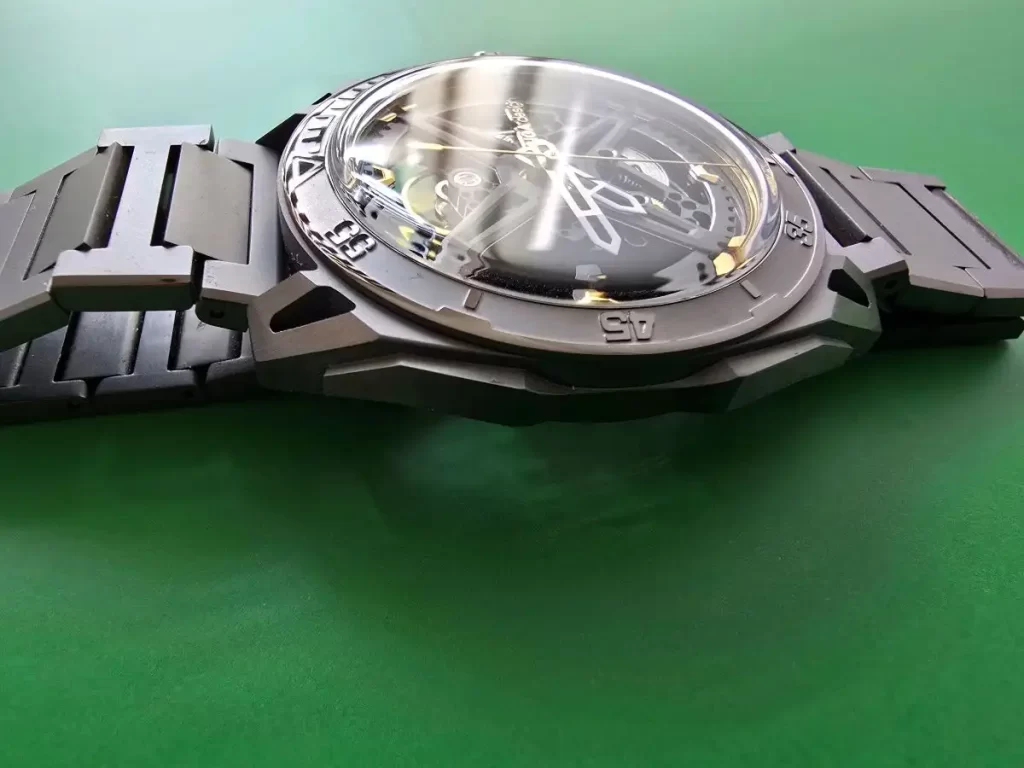
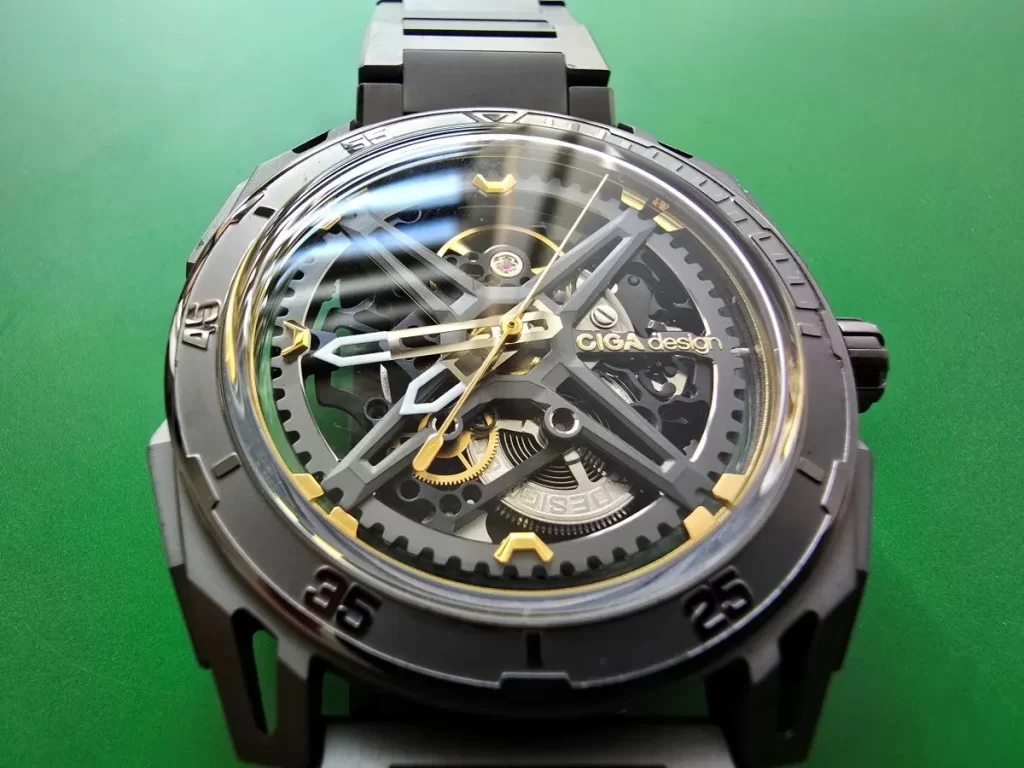
CIGA design Falcon sits in a 43.5mm round 316L stainless steel case that measures 11.1mm at its thickest point and 47.9mm lug to lug. Those numbers sound big on paper, but on the wrist the watch carries itself with surprising lightness. The short lug-to-lug keeps it manageable on a wide range of wrist sizes.
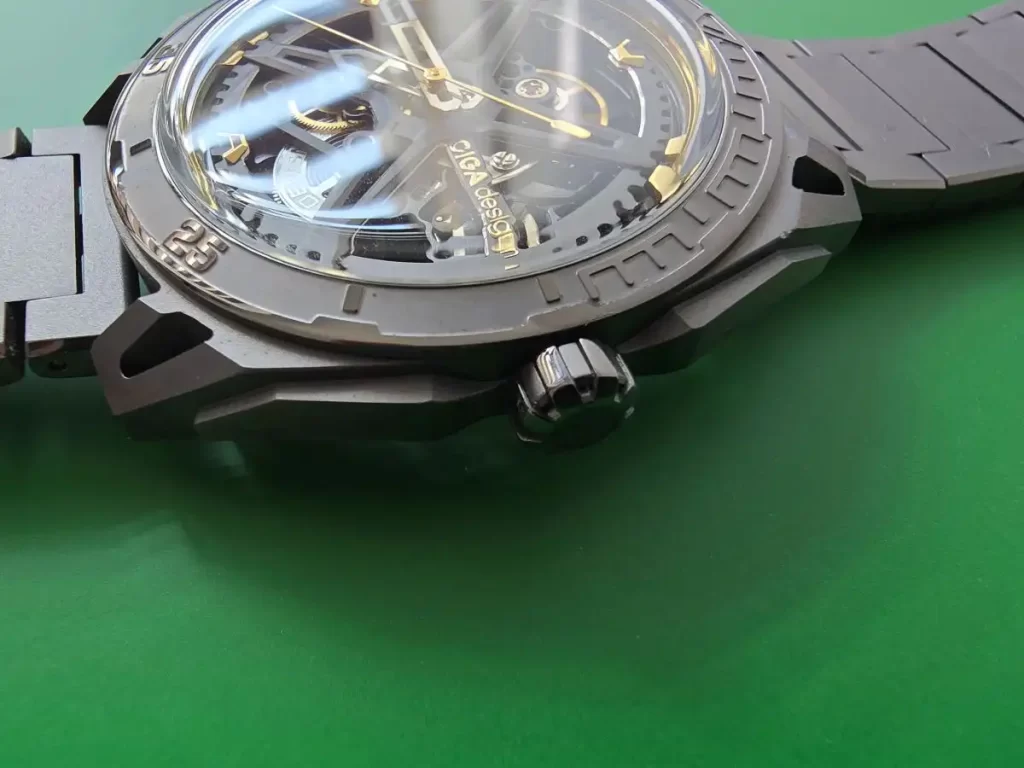
CIGA went heavy on the contrasts. Most of the case surface gets a micro-sandblasted matte finish. The open-worked lugs pick up a vertical satin grain along their edges. The result is a case that looks expensive without announcing itself as such. And the golden accents helps a lot.
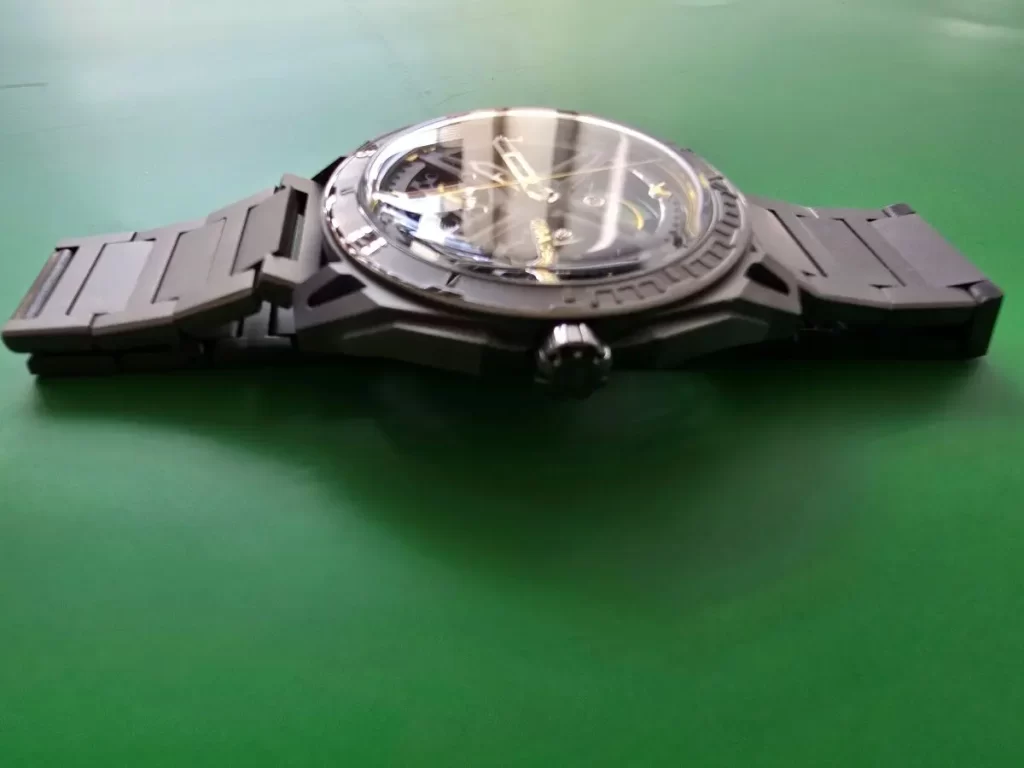
The lugs deserve a separate mention. They are fully hollowed out, which contributes both to the watch’s weight savings and to its aggressive visual character. From the side, the Falcon looks like something an industrial designer drew while in a good mood. From the front, it looks like it wants a fight.
Crown guards flank the crown symmetrically. They add to the muscular shoulder of the case while protecting what is a large, nicely grooved crown. It is not screw-down, which is a minor concession at this price, but more on water resistance shortly.
Dial
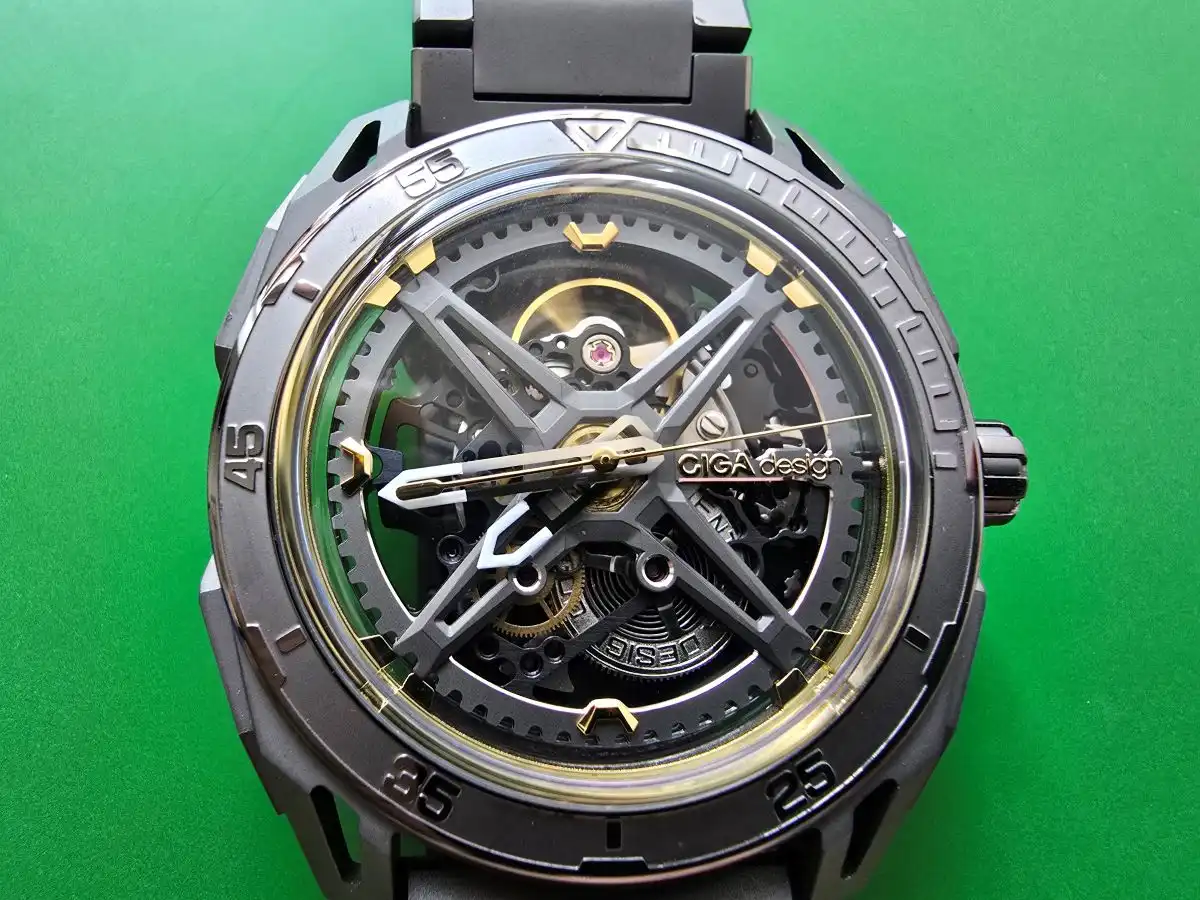
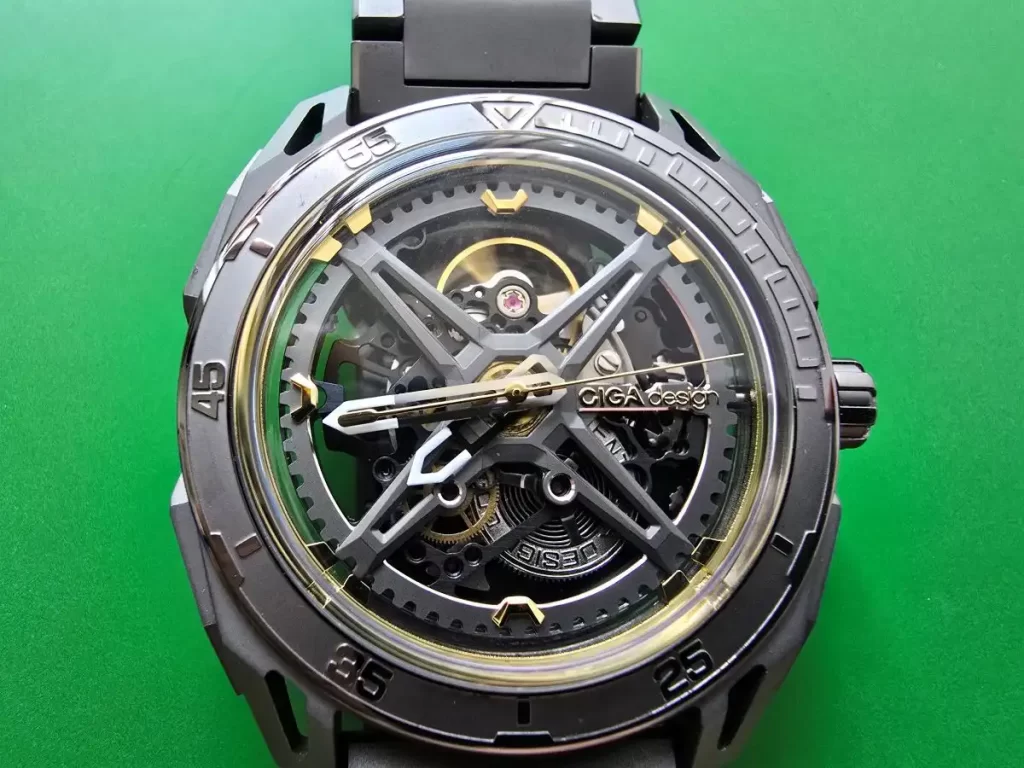
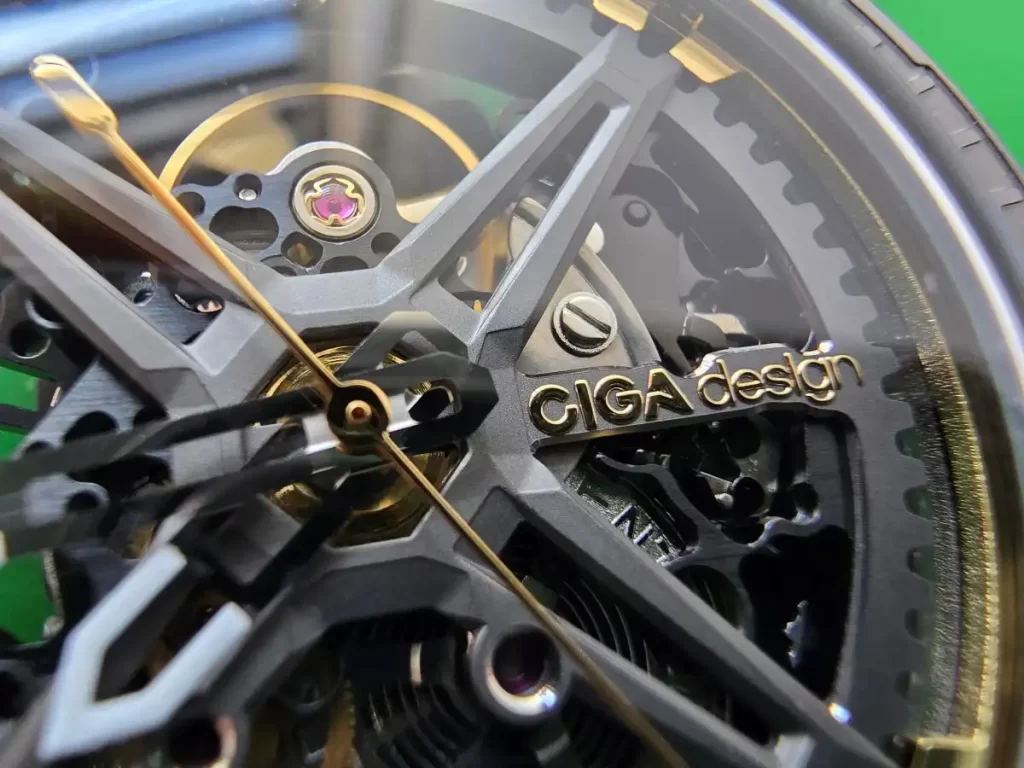
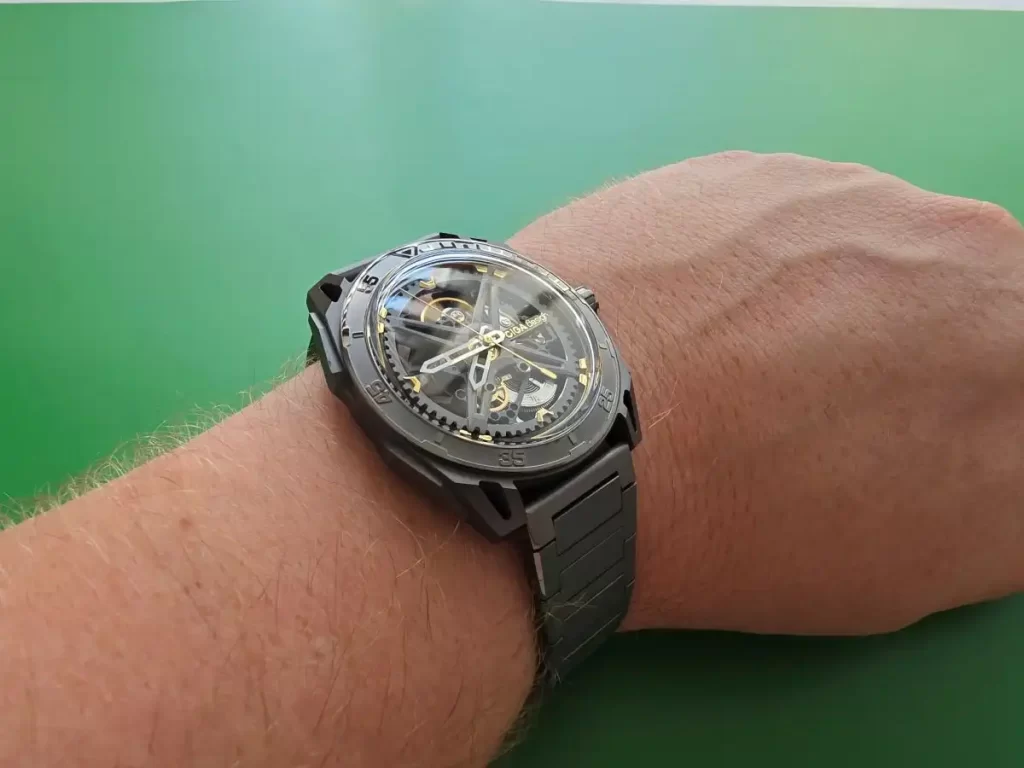
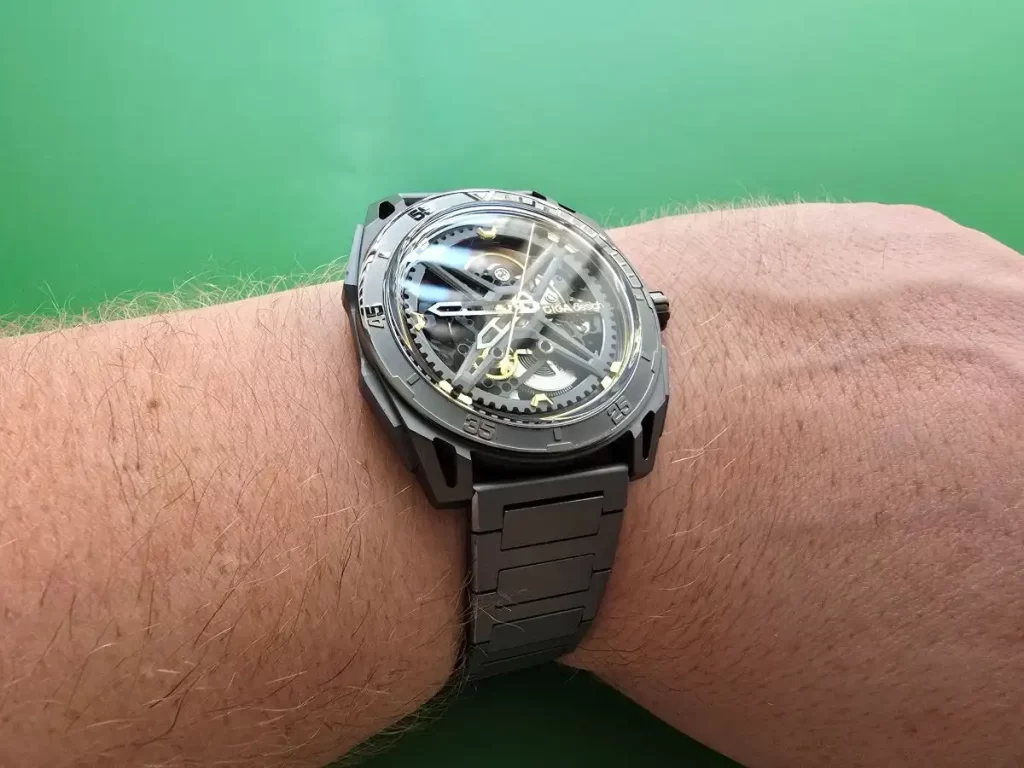
There is no dial here in the traditional sense. What you see through the heat-hardened mineral glass is the movement itself: the self-developed CD-02 caliber, fully exposed front and back.

The dominant visual element is the X-shaped upper bridge that runs across the center of the movement. Around the periphery, a gear-toothed plate doubles as the chapter ring, its sixty teeth marking the minutes and seconds in a way that feels mechanical and intentional rather than decorative. The mainspring barrel sits open to view, the gear train is exposed, and the balance wheel beats visibly at 12 o’clock.
Three centrally mounted hands complete the picture. The hour and minute hands use a skeletonized fence-post construction with Swiss Super-LumiNova-tipped ends in white. The second hand is extremely slender and done in gold colour. It is a bold, high-contrast choice that works.
The bezel is fixed with a dive scale in relief. CIGA describes the Falcon as a sports watch, and the bezel supports that framing, though it does not rotate and the watch is not a diver. Think of it as visual structure: a recognizable, readable frame that anchors the complex skeletonized interior.
Strap / Bracelet
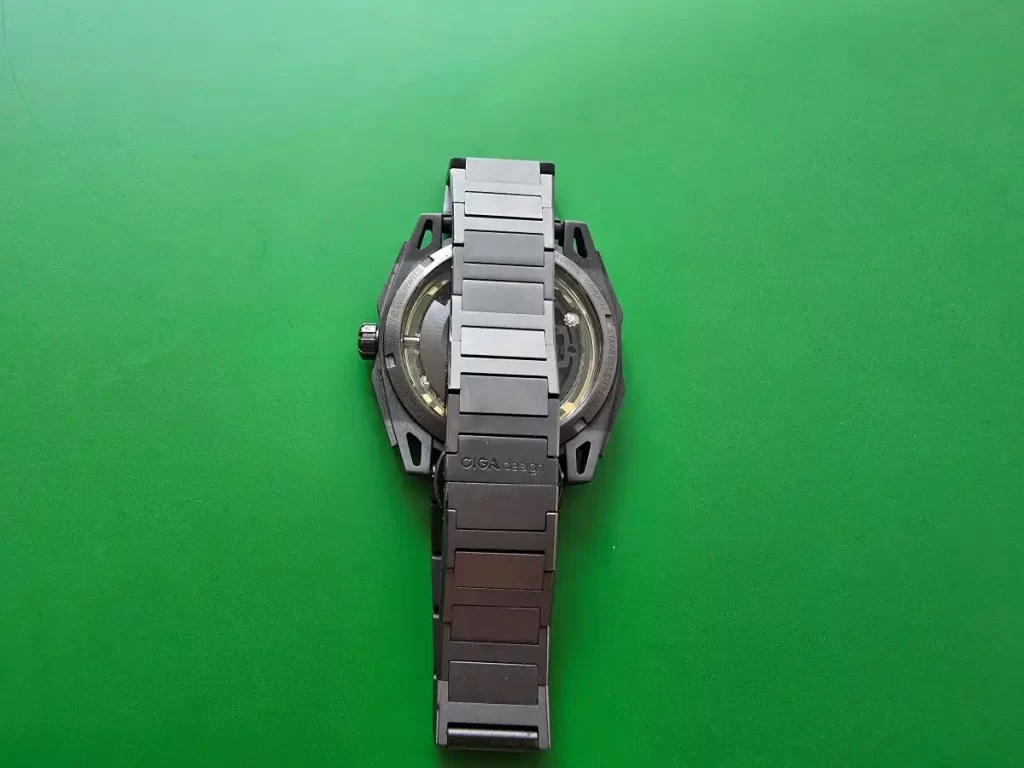
The Falcon ships on an H-link steel bracelet just like the Hunter which we recently reviewed . The links are micro-sandblasted with chamfered polished edges, and the whole assembly tapers from 22mm at the lugs down to 17.5mm at the push-button hidden clasp. It is elegant and practical in equal measure. The quick-release system means swapping to an aftermarket strap takes seconds.
The bracelet adds very little weight. On a 7.25-inch wrist, the Falcon on the bracelet weighed just 125 grams, which is what you would normally expect from a 43.5mm watch on a leather strap, not a steel bracelet. The hollow case and skeletonized movement explain the savings.
Build Quality and Durability
CIGA design Falcon uses 316L stainless steel throughout: case, bezel, bracelet, crown. The finishing quality for the price is genuinely impressive. You get two distinct textures playing against each other across every surface, and the execution is clean and consistent.
Water resistance sits at 5 ATM (50 meters). You can wear the Falcon through rain, hand washing, and accidental splashes without concern. Do not scuba dive with it. Given that this is clearly a casual and dress-adjacent sports watch, 50 meters is appropriate and sufficient for them, but for me It should be at least 100 meters. I mean look at the Tissot Golden Oak, a limited edition, dress watch that has 100 meters water resistance
The glass is heat-hardened mineral with an anti-reflective coating. It is not sapphire, which means it is more susceptible to scratching than you would find at higher price points. CIGA compensates by giving the glass a slight dome that lifts it above the bezel, which adds to the visual depth but also exposes it slightly more to knocks. At $499, this is a fair compromise. Just be aware of it.
The case back screws down and features a large display window. Through it you see the rotor, decorated with Geneva stripes and a brushed finish. The rotor is not skeletonized, which would have been a nice touch for rear visibility of the movement, but it is a minor omission.
Movement and Functionality
This is where the CIGA design Falcon separates itself from most watches in its price category.
The CD-02 is CIGA Design’s own caliber, developed in-house and built from the ground up to be skeletonized. That distinction matters. Most skeleton watches at this price take an existing movement and strip material away. The CD-02 was designed as a skeleton from day one, which shows in how naturally the architecture flows visually. Nothing looks like it was removed. Everything looks like it was placed.
The movement beats at 28,800 vph (4Hz) and carries 26 jewels. Power reserve is 40 hours. Functions are hours, minutes, and seconds only. No date. No complications. Just time, displayed through a window into the mechanical soul of the watch.
On a timegrapher, the CD-02 delivered an average accuracy of +8 seconds per day across multiple positions, with zero beat error. The official specification is -15 to +30 seconds per day. In real-world terms, the Falcon keeps time better than its spec sheet suggests. For an automatic movement at this price, that is a strong result.
Crown operation is straightforward: resting position allows manual winding, pulling to position one stops the seconds hand for precise time setting. Pushing the crown back in produces no minute hand jump. It is a clean, well-calibrated interaction that you appreciate after dealing with sloppy crown feel on other affordable automatics.
Comfort and Wearability
The Falcon wears much lighter than its dimensions suggest. At 125 grams on the bracelet, it never produces wrist fatigue, even after a full day of wear. The short lug-to-lug length of 47.9mm means the watch stays centered on most wrist sizes and shapes without the ends of the lugs fighting for space.
The bracelet is more comfortable than most bracelet-wearing skeptics expect. There are no sharp edges digging into the wrist, and the push-button clasp opens cleanly. The one legitimate complaint: there are no micro-adjustment links. You either nail your size when removing links, or you live with it being a touch loose or tight. Most people size it correctly on the first go, but the option would still be appreciated.
On more formal occasions, the Falcon holds its own. It reads as a statement piece rather than a sports watch in a suit situation, which depending on your wardrobe is either a plus or a minus. In casual settings it is unambiguously at home.
Features and Technology
The Falcon does not have complications, smart functions, or solar charging. What it has is a full-skeleton construction executed with far more discipline than the price suggests.
Luminescence comes via Swiss Super-LumiNova on the tips of the hour and minute hands. It is adequate rather than exceptional. The pip at 12 on the bezel does not glow. In a dark room, reading the time takes a moment of orientation. That is the honest tradeoff of skeleton watchmaking at any price.
The anti-reflective coating on the mineral glass does useful work. The domed glass, paired with the coating, makes the movement readable from most angles without fighting glare.
There is no power reserve indicator. With 40 hours of reserve, you can leave the Falcon off the wrist Friday evening and pick it up Saturday morning without winding. If you leave it on the nightstand over a long weekend, you will need to set the time and wind it by hand before wearing.
Brand and Heritage
CIGA Design, which stands for China International Great Art, was founded by Chinese industrial designer Zhang Jianmin with a specific goal: prove that “Made in China” can mean excellent design and build quality, not just low prices. The brand built its foundation on skeleton watches produced using Shenzhen’s manufacturing infrastructure, then expanded globally through Indiegogo campaigns that broke platform records.
In 2021, the CIGA Design Blue Planet became the first Chinese brand to win at the Grand Prix d’Horlogerie de Genève, the Oscars of watchmaking, beating 208 entries to win the Challenge Watch Prize. That is not a minor achievement. It is the kind of validation that Swiss brands with decades of heritage sometimes never receive.
Since then, CIGA has maintained an aggressive release schedule across central tourbillons, wandering hour complications, and skeleton designs. Their most expensive watch, the Everest Summit with its central tourbillon, retails at $2,699. The Falcon, at $499, sits at the accessible end of their lineup while still carrying the same design DNA and manufacturing philosophy.
The Falcon is significant within the CIGA lineup because the CD-02 is their first self-developed automatic movement purpose-built for skeleton display. It is not a milestone buried in press release language. You can see it directly on your wrist.
Price and Value for Money
The Falcon retails for $499.
For comparison: the D1 Milano Gun Metal Skeleton, a broadly similar sports skeleton on an ETA-sourced movement, costs $775. The Tissot T-Complication Squelette, a well-regarded skeleton with a hand-wound Swiss movement, costs $2,295. The Hamilton Jazzmaster Skeleton Auto costs $1,545. The Mido Multifort Skeleton Vertigo costs $1,330.
The Falcon is by far the most distinctive design of that group, offers the most extensive skeletonization, and matches or exceeds the specifications of most of those options at a fraction of the price
A Swiss watch with this level of skeletonization, an in-house movement, and this quality of execution would cost tens of thousands, not $499.
The Falcon is not cheap. There are less expensive skeleton watches. They are not in the same conversation. The Falcon is affordable, which is a different thing entirely.
Pros and Cons
Pros:
- In-house CD-02 movement designed as a skeleton from inception, not adapted
- Genuinely excellent finishing for the price category
- Surprisingly lightweight at 125 grams on the bracelet
- Strong real-world accuracy (+8 seconds/day average)
- Short lug-to-lug makes it wearable on a wide range of wrist sizes
- Bracelet is comfortable and well-built
- Price vs. visual drama ratio is essentially unmatched
Cons:
- Mineral glass, not sapphire: scratching is a realistic concern over time
- Legibility at a glance requires a moment of orientation
- No micro-adjustment on the bracelet
- Non-screw-down crown (minor at 50m rating)
- Rotor not skeletonized: rear view of the movement is partially obstructed
- 40-hour power reserve is adequate but not generous
Target Audience
The Falcon works best for watch enthusiasts who want visible mechanical drama without the price of Swiss skeletons. Design-focused buyers who judge a watch by how it looks on the wrist rather than the name on the dial will appreciate what CIGA has delivered here. It also suits newer collectors who want an impressive conversation piece as an entry point into serious horology.
It is not for someone who needs quick legibility, strong lume performance, or the reassurance of Swiss provenance. It is for someone who puts the watch on their wrist and wants to spend the next ten minutes looking at it.
Box and Packaging
CIGA design Falcon comes in a booklet-style gift box that opens through a tactile page-turning experience, made from premium recycled paper. It is not a generic clamshell. The unboxing feels deliberate and considered, which is a nice signal about how CIGA presents its products. Inside the box: the watch, the H-link bracelet, and a warranty card. Exactly like the other boxes, we are used with it at this point.
Nothing fancy, nothing new, just simple like CIGA design Time Cipher box.
CIGA design Falcon – Might be my favorite one yet
The CIGA Design Falcon is one of the most compelling sub-$500 automatic watches available right now. Full stop.
It earns that position not through specification superiority, but through the combination of a purpose-built in-house skeleton movement, thoughtful industrial design, solid execution across case finishing and bracelet construction, and a price that leaves competitors with no rational answer.
You give up sapphire glass, a screw-down crown, and some legibility. You gain a watch that stops people in their tracks, a movement that was designed to be looked at, and the quiet satisfaction of knowing you paid $499 for something that looks like it belongs on a shelf at ten times that price.
If you are in the market for a skeleton automatic that punches far above its weight, buy the Falcon.
| Specification | Details |
| Brand | CIGA Design |
| Model | Falcon |
| Reference | N/A |
| Price | $499 USD |
| Case Material | 316L Stainless Steel |
| Case Diameter | 43.5 mm |
| Lug to Lug | 47.9 mm |
| Thickness | 11.1 mm |
| Weight | 125 g (on bracelet) |
| Water Resistance | 5 ATM / 50 meters |
| Crystal | Heat-Hardened Mineral, Anti-Reflective Coating |
| Caseback | Screw-Down with Display Window |
| Crown | 316L Steel, Grooved, Non-Screw-Down |
| Bezel | Fixed, Dive Scale, Layered Polished / Micro-Sandblasted |
| Movement | CIGA Design Caliber CD-02, Self-Developed |
| Movement Type | Automatic |
| Functions | Hours, Minutes, Seconds |
| Beat Rate | 28,800 vph / 4 Hz |
| Jewels | 26 |
| Power Reserve | 40 Hours |
| Accuracy | -15 / +30 sec per day (official) |
| Dial | Open Skeleton / Back-to-Front |
| Lume | Swiss Super-LumiNova, Green (hand tips) |
| Hands | Skeletonized Hour & Minute (green lume tips), Red Seconds |
| Bracelet Material | 316L Stainless Steel, H-Link |
| Bracelet Width | 22 mm at lugs / 17.5 mm at clasp |
| Clasp | Push-Button Hidden Deployant |
| Available Variants | Carbon, Silver |
| Lug Width | 22 mm |
More information on CIGA design official website